Showing posts with label Cremona. Show all posts

Saturday, March 2, 2019

Cremona & Crema (29/06/2018)

After graduating in Krakow and having come back to Italy, I decided to join my aunt once again and go with her to Cremona, since it is where she had to work there that day.  I had already visited the city of Cremona three years prior, but I had missed some things to see and was then planning to follow my aunt to the next town she was heading to. So after being dropped off in the city center, I directed myself, thanks to the ever-present bell tower jutting out among the rooftops wherever you were, to the city´s main square. I gave a quick look at the impressive Cathedral, which having previously visited, nonetheless amazed me each time I saw it. From there I walked a little bit before reaching the Archaeological Museum. Since 2009 it is hosted in the Church of San Lorenzo, dating to the 12th century and in the Romanesque style, it now holds the collection of mostly roman antiquities with a few pieces from the middle ages. I particularly enjoyed it and the Roman mosaics inside were worth a visit, as well as the Cappella Meli, a 15th-century chapel annexed to the church. After the visit, it was time to have lunch so I met up with my aunt and we went to eat at a place called Hosteria 700 where I had some really tasty ravioli with pumpkin, though there were just a few and I was filled yet so I shared an appetizer of cold cuts and cheese with my aunt. After lunch, we got in the car and headed to the next town: Crema. Similarly named, this town is the province of Cremona but actually half between it and Milan. So after getting off the car, I headed towards the main square first, passing by the Cathedral which was still closed for lunch break.  Right in front of the church´s facade stands the impressive Arco del Torrazzo, built in the Renaissance style during the 16th century. On the side of the square is a fresco on its central part, while on the opposite side is a statue of the Lion of St Mark, symbolizing that once Venice used to dominate the town. The arch divides the Palazzo Comunale in half, which dates from the same period and holds the coat of arms of mVenetiantian patrician families which ruled the city from there. Now it still serves the function of administrative office but by the local city council. Right next to it, on the northern side of the square, is the Palazzo Pretorio which used to be the residence of the Venetian Podestà, who ruled over the city. At its center stands a 13th-century tower with the lion of St Mark. From there I walked along the streets of the city center passing by the nice Baroque Palazzo Bondenti Terni de Gregory, set in a small picturesque square. Then I decided to head out of the old town and reached in about twenty minutes of walking the Santuario di Santa Maria Della Croce. It was built in the 15th century, in the typical Lombard Renaissance style, in the location of a supposed miracle. The story goes, that a certain Caterina Degli Uberti, part of a noble family from Crema, had to marry a bandit from the area of Bergamo named Contaglio, who wished her just for her dowry. In fact, just a year after the marriage, as they were leaving the city, the man attacked his wife with a sword, amputating her hand and leaving her to die on the ground. Before dying, Caterina invoked the Madonna to allow her to get the sacraments before dying. Miraculously the bleeding stopped and she was helped by passersby to a nearby house. It was late so they had to wait for the next day to be then brought to Crema where she was first visited by a medic and then blessed by a priest on her request. After the blessing was over, the bleeding started once again and the lady died shortly after. Because of this story, the church was built on the site of the apparition and subsequent miracles were said to take place. So after reaching the complex I entered through the main door and found myself in a large circular room, with a painted ceiling and nice renaissance and baroque altars and decorations. I then headed back towards the city center and entered the Cathedral, which had finally reopened. Built between the 13th and 14th centuries, it features a mostly Gothic structure, with the exterior made in the typical red Lombard Gothic and the interior featuring some Romanesque parts. The interior was quite dark,  and despite the 18th-century restructuring highly damaged the interior, there were still some medieval frescoes to see. The bell tower, which just from the southeastern part of the church is very similar to that of Cremona, both in aspect and style, but much smaller in size. Walking through the Arco del Torrazzo I then reached and entered the Church of the Santissima Trinita, a classic example of sumptuous Baroque and dating from the 18th century. Nearby I then gave a quick look at the Santuario di Santa Maria Delle Grazie, built at the beginning of the 17th century in the Mannerist style, and with frescoes dating to the latter part of that same century in a more baroque form. After the church, I continued my walk and passed by the Baroque Palazzo Premoli, and passed the pretty square Piazza Trento e Trieste where the Teatro San Domenico is located, inside the former Church of San Domenico. I then reached the main square, Piazza Duomo, again where I then called my aunt to meet up and head back to Vicenza.

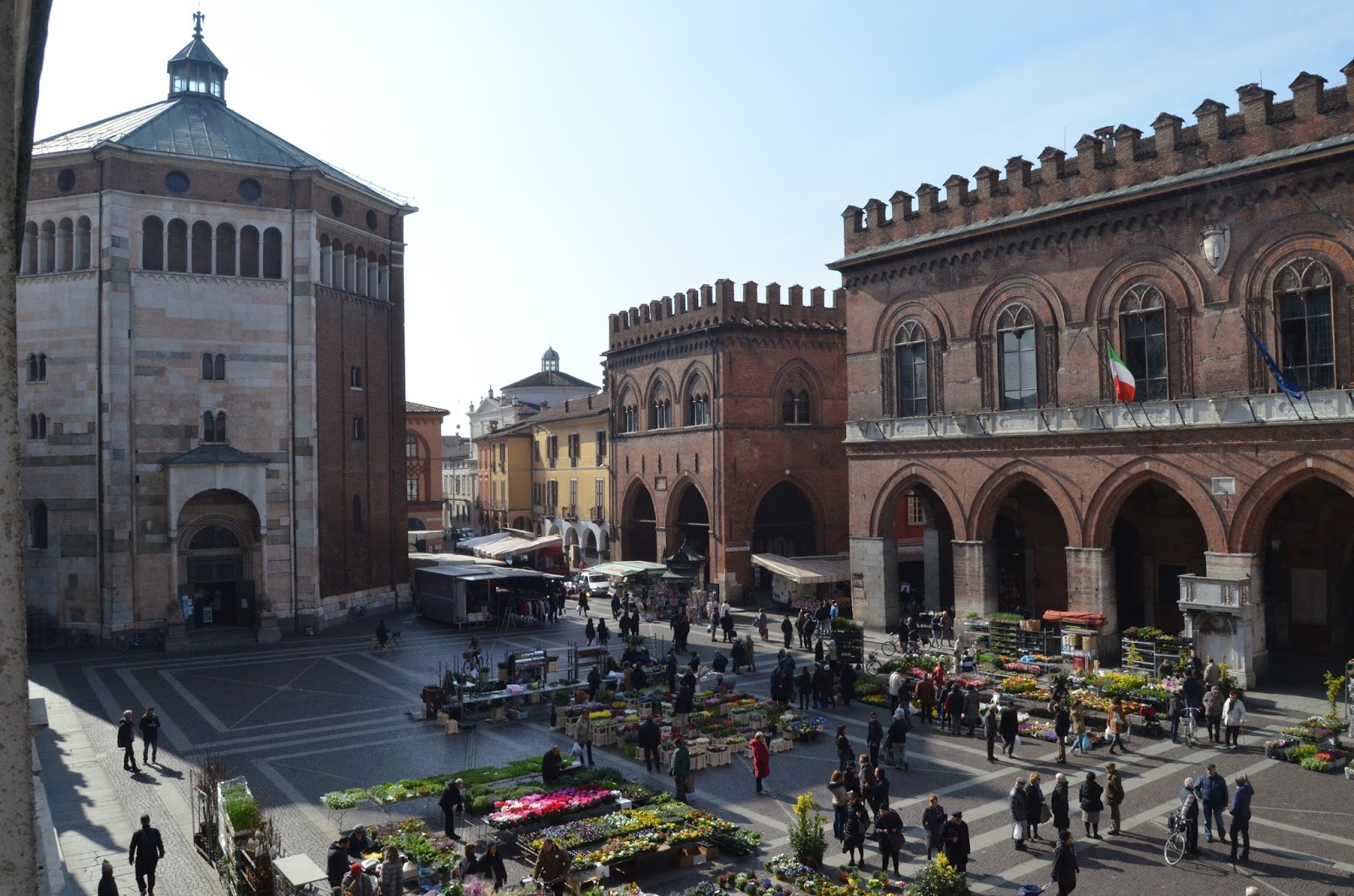
View of the main square and Cathedral of Cremona
  
The Torrazzo of Cremona
  
The archaeological museum
  
The bell tower of Crema's Cathedral  
The Piazza Duomo in Crema


The Arco del Torrazzo

Crema's Cathedral facade

The Torre Pretoria
  
The backside of the Arco del Torrazzo

View of one of the streets in Crema
   
The Palazzo Bondenti Terni de Gregory
  
The Santuario di Santa Maria della Croce  
Another street in Crema

  
The Cathedral and Bell Tower
  

Tuesday, March 22, 2016

Cremona (03/02/2016)

On this day I decided to travel with my aunt who usually works out of town and travels a lot so I decided to get a lift to the city of Cremona. After being dropped off in the city center I immediately headed towards the main square. The bell tower, the second highest in Italy, was immediately visible from the highway so I just had to look up to figure out the way. Once I reached the impressive Piazza del Comune, I was awed by the beauty of the Cathedral and the bell tower right next to it. The Duomo, built in the Romanesque style, had several later additions in the Gothic, Renaissance and Baroque style. The facade built in the 13th century is an absolute masterpiece and surely one of the best looking in Italy. I then went inside, and marveled at the Baroque decorations which covered most of the interior yet did not seem out of tone with the older structure of the building. There were still several medieval decorations such as a few frescoes and tombs. The main painting of the church hangs on the counter facade and is the Crucifixion by Pordenone. I then decided to head out to visit the rest of the square. Right in front of the Cathedral are two medieval buildings, the Palazzo del Comune, or City Hall, and the Loggia dei Militi, or Soldier's Loggia which served as another government building. From there I turned right and bought the combined ticket for the bell tower and the Baptistery, and headed up the tower first. The so called Torrazzo, is the third tallest brick tower in the world, and the oldest among those 3 towers. Completed in 1309 its height reached 112m and after having walked up more than 500 steps I reached the top where I had a wonderful view over the town below and the surrounding countryside and the Po river towards the south. It was also really nice that I was the only tourist and visitor up there enjoying the views. I then descended the stairs and went in the Baptistery. A friendly old man at the ticket booth asked me where I was from and started talking about the building's history and of the city too. Built around the time of the Cathedral it's another wonderful example of Romanesque architecture, and as most other Baptisteries it was built in an octagonal plan. The interior though not frescoed as other Baptisteries, still had a nice look to it. It was time for lunch so I asked for some suggestions at the tourist info point and went with the nearby Ristorante Centrale. Though a bit old looking on the inside (like an 80s decor) I had a really good typical Cremonese dish: tortellini in broth.  After lunch I headed north and after walking a few block I reached the city's main museum; The Ala Ponzone Museum. Inside were several 16th and 17th century paintings such as a beautiful and strange painting called the Ortolano by Arcimboldo, a famous 16th century painter known for representing people with fruit and vegetables. There were also some rooms with 18th and 19th century pantings, a part with asian porcelains and an archaeological section with greek and roman objects, and finally a last room with the famous violins of which Cremona is known worldwide. After exiting the museum I walked along a few streets passing by some really nice palaces, such as Palazzo Fodri and the Palazzo Stanga Trecco with a really nice courtyard with a renaissance loggia. I then walked on and reached Via Garibaldi, where the house of famous luthier Stradivari stands. Not far up the street is another medieval building very similar to the city hall called Palazzo Cittanova, and right in front the Church of St Agatha rebuilt in a Baroque and Neoclassical style with a famous painting by Boccaccio Boccaccino. Close by was another splendid palace, and probably the best looking in the whole city; the Palazzo Trecchi. First built in the 15th century it was then refurbished and modified in the 19th century and had some beautiful red columns and loggias all around the courtyard. There was even a small plaque showing the place where Garibaldi had a picture taken of him on horseback. On the same street not far, I visited the small yet very nice church of Santa Rita, with some great renaissance paintings and colorful marbles. Walking on I then entered the Baroque church of Sant'Ilario and passing by the beautiful Renaissance Palazzo Raimondi, which seemed it would fit much better in Ferrara than a city of Lombardy, and reached the church of San Luca, which still had some medieval traces remaining particularly the facade, and some of the columns inside, one of which had a strange jewish incrisption. From there I headed back in towards the city center and stopped at the church of Sant Egidio e Omobono, which looked closed and under restoration but the guardian, seeing me peek inside, asked me if I wanted to enter and I responded affirmatively. He then asked me where I was from and happily remarked he had visited Vicenza in the past and had really liked it. After my visit he then suggested I go visit the church of Sant Agostino which had a famous painting by Perugino. In fact not far ahead I reached said church, which had a beautiful interior with a mix of Renaissance and Baroque decorations, particularly rare and interesting were the statues decorating the central nave. I then admired a beautiful marble chapel and right next to it the Cavalcabó Chapel with interesting frescoes and finally the magnificent painting by Perugino. It was then time to head back home, and while waiting for my aunt to come pick me up I decided to give one last look at the main square with the magnificent Cathedral.

Interior of the Cathedral

View of the Cathedral and the bell tower, Torrazzo

View of the main square with the Palazzo del Comune, Loggia dei Militi and Baptistery

View from the top of the Torrazzo

View of the city from the Torrazzo

Another view from the top

View of the Cathedral and Baptistery

The Ortolano by Arcimboldo, if turned upside down it looks like the portrait of a man

Painting of Cremona

Palazzo Trecchi

The painting by Perugino

Modern and old architecture