We (Simona, Marija, Francesca and I) took a bus from Coimbra at 9 and got in front of the Buçaco Palace at around 10. The area surrounding the Palace, which is now a Mata Nacional or national forest, used to be a protected woodland region belonging to a Carmelite monastery and surrounded by walls which are still intact. It has to be noted in fact that 2 popes, Pope Gregory XV in 1623 and Pope Urban VIII in 1643 issued bulls prohibiting women to enter and threatening with excommunication whomever harmed the trees. There are many interesting plants and trees coming from all parts of the world, and a really nice part is the Valley of the Ferns, a small path covered in beautiful giant tree ferns that reminds of Jurassic Park. The monastery that used to own the land built in 1628 is still there; the small chapel with a few of the monks cells still remaining, now incorporated in a luxury hotel. The hotel that we now see was first conceived as a royal residence for the king and queen of Portugal Louis I and Maria Pia, however the idea was scrapped and a hotel was built instead. Construction started in 1888 and ended in 1907, under the supervision of Italian architect Luigi Manini; and what came out was a beautiful romantic palace built in a Neo-Manueline style with resemblances of the Tower of Belem and Jeronimos monastery in Lisbon. A major battle in the Napoleonic Wars took place around the forest in 1810 when the French general Massena was defeated by the British Duke of Wellington who then spent the night at the monastery. So after taking a look of the garden outside the Palace we decided to walk around the forest and reach the highest point of the area. So we took a path that lead through the so called Via Crucis, a recreation of the way Jesus had to take with the cross on his back, among some chapels surrounded and covered by trees all the way to the top where a big cross stood at 549m with a beautiful view of the surrounding forest, the palace and the plains leading to Coimbra and then the ocean. Coming back down we got to the Palace again where we decided to have so we could see the interior too. It was then time to head back home, so we walked down to the town of Luso, famous for its natural spring water sold all around Portugal; we did in fact fill up our bottles with it before reaching the train station where we eventually took the train back home.
Saturday, October 17, 2015
Friday, October 16, 2015
Conimbriga (24/10/2014)
I decided to visit the roman ruins of Conimbriga located 20km south of Coimbra. I took an early morning bus to the village of Condeixa-a-Nova and then walked a couple of kilometers to reach the entrance of the archaeological site. The ticket with student discount cost 2,50€ and included both the ruins and the small museum. The archaeological site is considered to be one of the best preserved in the Iberian Peninsula. I started my visit by following the roman road that headed towards the center of the town, where the roman forum once stood. The area where the site is located, used to be inhabited already in the 9th century BC and when the Romans came around 139 BC they started building what we can see today. Some domus houses are now located outside the walls, constructed on top of other houses to defend the population from Suebian invaders, that inevitably conquered and sacked the city forcing the roman population to seek refuge in Aeminium nowadays Coimbra. I turned left right before the main gate and saw several interesting mosaics such as those of the House of the Swastika and that of the House of Skeletons. Further on I passed by where the baths once stood and reached the biggest domus in Conimbriga, the House of Cantaber, that did not have any mosaics left, but presented a well kept impluvium and overall plan of the many rooms it had. I then walked on and reached the great thermal building built overlooking the ravine of the river flowing right around the town. After that I passed by the remains of the forum and then back out through the main gate, where I reached the really nice House of the Fountains. This was the only domus that had a protective cover built since most of its mosaics are nearly perfectly preserved. In fact the colors were still very bright as was with their geometric patterns and figures. The peristyle, that still had a few columns and water running through it, was surrounded by beautiful mosaics such as that showing a group of horsemen, Perseus holding the head of Medusa, one with dolphins, and one with sea monsters and fish. After the visit of the ruins, it was time to head to the small museum that contained the several archaeological remains found when digging up the site. The visit was over and I decided to head back home, as previously decided; by foot. The 20km took me nearly 5 hours but it was a pleasant walk as I also thought that even though I had visited many roman ruins back in Italy, this one really surprised me especially with its wonderful mosaics.
| Mosaic of the House of the Skeletons |
| View from the ruins |
| View of a part of the House of Cantaber |
| Mosaic of Perseus holding the head of medusa |
Labels:
archaeological,
Coimbra,
Conimbriga,
october,
roman,
ruins,
site
Thursday, October 15, 2015
Peniche (19/10/2014)
I was able to find a guy through Blablacar that was headed for Peniche, so at around 7 am, Zach and I were in front of the hotel Astoria waiting to be pocked up. The drive took about one hour and a half and in the meantime the driver, whose name was Nuno, told us that he was going scuba diving off the coast of Peniche at the Berlengas islands. So he dropped us right in front of the beach and told us he would come back to pick us up at around 6 pm. This day, at the Supertubos beach, an internationally known beach for surfing, was taking place the Wolrd Surfing League competition, where the best and most famous surfers were present. So we took place on the front, near the surf where the waves crashed, and waited for the start of the competition. We some great moves and had a great view too. After the main surfers had surfed, it was time to go explore the town itself. We headed north from the beach and 20 minutes later reached the town center. First thing we visited was the Fort, built in the 16th century, and now a military museum (as most forts in Portugal are). After the visit we started to look for a place to have lunch, and found a nice little restaurant on the waterfront. We then continued walking through the center and reached the western end of the peninsula where the Cabo Cavoeiro was located. It had a nice lighthouse from where we could see the Berlengas islands not too far in the distance. It was then time to had back, so we started walking towards Supertubos beach, once again passing through the city center. We had some extra time to dip our feet in the cold water and then hopped on the car ready to head back to Coimbra.
| John John Florence, famous surfer |
| Surfer riding a wave |
| Fort of Peniche |
| Inside the Fort |
| Cliffs of Peniche |
Wednesday, October 14, 2015
Fatima, Batalha, Alcobaça and Obidos (12/10/2014)
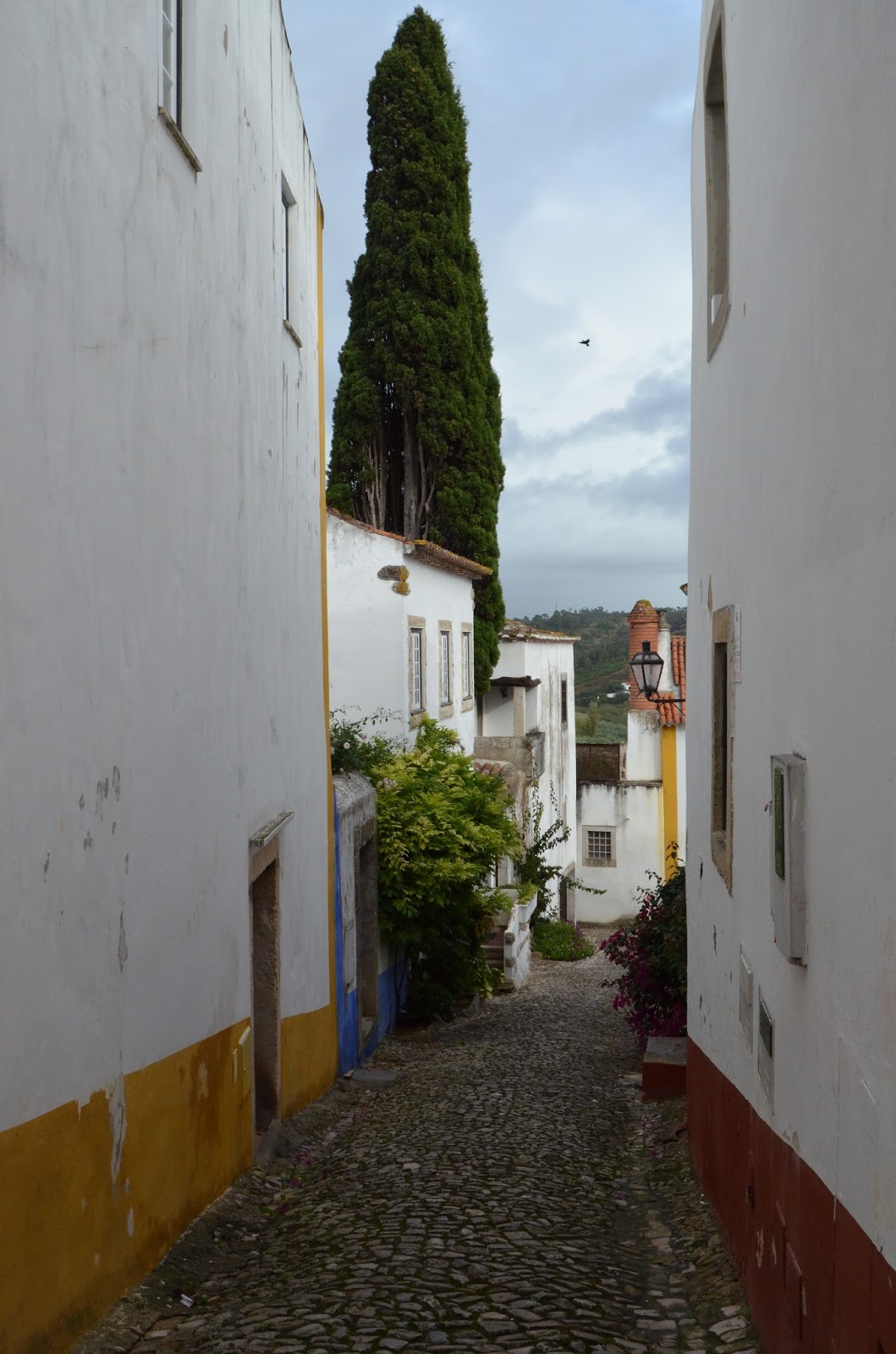
This trip was organized by Quebra Tour a travel agency based on the Quebra costas stairs just below Sé Velha in Coimbra. We took an early bus, leaving at 7 in order to be able to see all four sites in one day. The first stop was Fatima, which I had visited the day before with ESN, so nothing new. Next we headed for the Batalha monastery, a UNESCO World Heritage Site. I was with Simona (my friend from Bulgaria) and we started exploring the beautiful Gothic and Manueline complex built to commemorate the famous battle of Aljubarrota in which the Portuguese army managed to defeat the Castilian one in 1385. As we entered, a magnificent bare and polished white nave showed us the way to the main altar, though we headed first to the right where the Founder's Chapel was located. This square chapel was built in the first quarter of the 15th century and became the first royal pantheon in Portugal. At its center are placed the tombs of King John I of Portugal and his wife Philippa of Lancaster, all around are other tombs of some Princes and Kings. We then headed on to the Royal Cloister, beautifully decorated and sculpted with spires and columns and also with fountains at each corner. Heading on, on the eastern side is located the Chapter house which now contains two tombs of the Unknown soldiers died in WWI guarded by two sentinels. Further, we saw the refectory, sleeping rooms and kitchen once used by the monks. The last part was dedicated to the famous Unfinished Chapels which show how the monastery was never fully completed, the roof is missing but the niches are there. After this we were back on the bus and heading for our next destination Alcobaça monastery, also a UNESCO World Heritage Site. Considered to be Portugal's first Gothic building, it was constructed around the 12th century. With a beautiful façade and a long and narrow nave, it is still Portugal's largest church. Once inside we started going around; we saw the Room of the Kings, the Chapter house, Sacristy, Dormitory, the beautifully vaulted Refectory that looked more like an inside cloister, and the kitchen with an incredibly huge and beautiful chimney with a canal flowing through it that would bring fresh water and fish from the nearby river directly in the kitchen (ingenious). Then we saw the D. Dinis cloister, which was the main one and very nice; there were also two other cloister which were closed (probably for restoration) the Levada cloister and the Rachadoiro cloister. We didn't have much time left so we quickly saw the remaining parts, including the famous and beautifully made tombs of D. Pedro I King of Portugal and his lover Inês de Castro. Legend goes: Pedro fell in love with a Galician noblewoman, Inês, but was prohibited to marry her by his father King Afonso IV. The King then ordered Inês death and Pedro destroyed by anguish decided to take revenge on her killers. After many years and having become King, Pedro ordered the exhumation of Inês corpse and ordered everyone to kneel in front of the decaying body and kissing her ring. This story was also famous in Coimbra since it is where it all happened, now the place being called the Fonte dos Amores in Quinta das Lagrimas. After the visit of the monastery we were left with our last stop on the trip: Obidos. This very nice medieval town, not too far from Lisbon and very close to Peniche, is completely surrounded by walkable walls and one of the best preserved in the country, no wonder its also one of the most visited sites. After hopping off the bus, we headed through the main gate and into the medieval town, colored houses already lining the narrow streets. Walking aimlessly, we traversed the town entered the Igreja de Santa Maria and reached the castle itself which is now a Pousada or luxury hotel. Here every year between July and August is held the medieval festival which attracts many people from around the country; but the most famous and internationally know festival is the Chocolate festival held in spring. After that we walked up some stairs and reached the top of the walls, where we circled the medieval town having some wonderful views to take pictures of. In the end we got back down in the city center and tried the typical drink of the town called Ginjinha or cherry liqueur which is served in a chocolate cup that can be then eater, very tasty! Overall it was a really nice trip even though a bit rushed especially for the two monasteries that alone could have taken half a day each to be thoroughly visited.
Tuesday, September 22, 2015
Tomar, Almourol, Fatima (11/10/2014)
This trip was organized by ESN and took us by bus to three different locations. After leaving Coimbra, early in the morning, we reached out first destination: Tomar. The town itself is famous for the beautiful and a Unesco World Heritage Site Convento de Cristo, or Convent of Christ, which was first built by the Templar order in the 12th century, and after the order's dissolution in the 14th century, became part of the newly formed Knights of the Order of Christ. The convent is surrounded by walls and there is a Keep guarding the entrance, built at the same time as the Templar church. After passing through the main gate, we waited outside in the garden while the Esn team was getting the tickets. As we went in, I was amazed to see the Romanesque part of the convent, the one built by the Templars, with its beautifully decorated and frescoed Rotunda, the only of its kind in Portugal, that took its shape from the churches in Jerusalem. The monastery was immense, and had a total of 8 cloisters, all from different periods and styles, my favorite was the Claustro de D. João III completed by the Italian architect Filippo Terzi, with beautiful arches and a wonderful fountain right in the middle. There was so much to see but we didn't have enough time so I tried seeing as much as I could, it was then time to get back on the bus and head to downtown Tomar. The city was very nice and had a beautiful Gothic church right outside the centre, the Igreja de Santa Maria dos Olivais which was a resting place for the knights of the Templar order. Once we crossed the medieval bridge we reached the old town with the main square and the Igreja de São João Batista which is the main church of the town, built in the 15th century. However the really interesting monument, hidden among the old narrow streets of the town, was the Synagogue ;the oldest one in Portugal. We then got back on the bus and headed for our next destination: the Castle of Almourol. This interesting castle sits on a small high-rised island in the middle of the Tejo or Tagus river. It is contemporary to the Convent of Christ and also a possession of the Templar Order. It is quite small but has some great view of its surroundings and of the river itself. After visiting the castle we headed on to our last stop: Fatima. This place was very strange in my opinion, because from a really small village in the middle of nowhere grew an immense town full of hotels (nearly as many as in Lisbon) and other structures, after the 1917 apparition. Later on in the 1950s the Sanctuary was built and in 2006 with the completion of the other basilica on the opposite side of the immense square, the place now just looks so strange and empty to me. It is probably not so during the mass pilgrimage which fills the huge square in May, the 13th to be precise, which is the day the apparition came to the three kids in 1917. But still at all other times, there are just some sporadic pilgrims and other tourists that visit the place and it just seemed "cold'' to me. The day was at an end so we got back on the bust and left for Coimbra in time for dinner.
| The Convento de Cristo |
| The Romanesque Rotunda built by the Templars |
| The Claustro de D. João III |
| The Igreja de Santa Maria dos Olivais |
| View of the Castle and Convent from Tomar |
| Tomar's Main Square |
| Portugal's oldest Synagogue |
| The Castle of Almourol |
| The Castle with the river Tejo |
| View from the walls |
![]() |
| The Sanctuary of Fatima |
Monday, September 21, 2015
Montemor-o-Velho (05/10/2014)
This time I decided to check out the beautiful castle I had always seen when travelling by train from Coimbra to Figueira, it is one of the best preserved in all of Portugal and also one of the largest, it first belonged to the Moors and was then captured by the christian forces in 848, while the keep and main walls date to the 12th and 13th century; the views from the walls are amazing, being the town surrounded by rice fields and the Mondego river flowing by. So I took and early train and about 40 minutes later I hopped off at Montemor-o-Velho train station. The station itself is just two train tracks with a road beside it, and it is located 4 kilometers south east of the town, so it took me about 40 minutes to reach by foot; i'm guessing there isn't even a bus that passes by. Once I reached the town, from below I could see the immensity of the hilltop castle, so walking from the main square where the Camara Municipal, or Town Hall, was located I took an elevator, yes there was an open air elevator to get to nearly the top of the hill (probably for the many old people living here) and headed for the main gate of the castle. Once inside, through the Porta da Peste, or Plague Gate, so called because as a legend mentions, two chests were buried under the castle one containing gold and the other containing the plague (meaning wealth or misery and death), I walked along the walls until I reached the ruins of the Capela de Santo Antonio and the Clock Tower, I then headed for the highest point of the hill, where the Igreja de Santa Maria da Alcáçova stands, from the 11th century but remodeled in the 16th century with some manueline styled additions. I passed by the ruins of the Palacio das Infantas, or the Palace when the castle was inhabited by kings and queens and didn't serve its military role anymore, and reached the Keep, the highest point of the walls, and from there I could have a beautiful view of the whole castle walls and the fields surrounding the town. At the centre of the castle stood the small tourist info point, where I asked for some info to an old man who wondered if I was Portuguese, I told him I was italian and he was surprised by fluency and gave me a pamphlet about the castle. Taking a few more pics I decided to go out through the southern gate or Porta da Nossa Senhora do Rosario, I descended into town and then walked out in the countryside to admire the castle's western walls. The view was incredible and well worth the detour. It was then time to go and as I had previously decided, I walked the 24km to Coimbra in about 4 hours and half totalling nearly 30km with the train station walk and touring around the castle.
| View of the castle coming from the train station |
| View of the surrounding fields from the walls |
| The Castle Keep |
| View from the Keep with the Santa Maria da Alcáçova church |
| The Porta da Nossa Senhora do Rosario or Southern gate |
| Beautiful view of the walls from the western fields |
Saturday, September 19, 2015
Algarve Trip with Esn (26-27-28/09/14)
![]() |
| The Meia Praia |
![]() |
| A street in Lagos |
am and the next morning we were up at 8 am and ready to head to the city centre and then the beach.
![]() |
| The Praia do Camilo |
We passed through the main gate that was once the main gate of the castle, and headed to see the Igreja de Santo Antonio, a very nice baroque church with a beautiful interior gilded woodcarving, and also inside is located the municipal museum with various roman sculptures and medieval azulejos.
Then we saw the Igreja Paroquial, or the main church of the town, baroque too and quite unappealing inside, and right across the square we saw the Mercado de Escravos or Slave Market, deemed to be the oldest in Europe, built in 1444. After walking through the old town streets, we started heading towards the beach.
![]() |
| The Praia Dona Ana full of Erasmus |
We passed by the Praia da Dona Ana, a really nice beach, the type of beach would come up to mind when thinking about the Algarve. We took several pics and walked along the top of the cliff with awesome views of the ocean and rocks jutting out of the water. We then reached Ponta da Piedade or Mercy Point, with beautiful natural rock arches and wonderful waters.
However there wasn't an actual beach to be able to lay down at, so we decided to turn back a little and reached the Praia do Camilo, a small and quite secluded beach where we cliff dived, swam and sunbathed for a while.
![]() |
| The group |
We then headed back towards the town and stopped at Praia da Dona Ana again, where eventually, after having woken up, all the other erasmus went to. We hanged there for a while and then headed home to take a shower before dinner. The dinner took place at the port, and the restaurant was filled with just us erasmus students, dishes were great and we had beerand wine all night long, the waiters continued to bring us beer and after a while we had too much.
![]() |
| Sagres lighthouse and beer bootle |
After dinner, there was going to be a party, but we were too tired from the few hours of sleep the night before, so we just opted to head home and chill with the leftover beer. The morning after we had to wait for every apartment to be ready so in the meantime we went to relax at the pool. Then around lunchtime we left and headed for Sagres, the south westernmost point in Europe, the view and cliffs there were amazing and the ocean did seem infinite from that point. After a quick walk around it was then time to go and we got back in the bus and left for Coimbra
Subscribe to:
Posts (Atom)