Showing posts with label mosaics. Show all posts

Monday, August 22, 2016

Pomposa Abbey (25/06/2016)

I decided to spend a weekend visiting my friend Mauro, and staying there for 2 days. We had planned to spend the time at the beach but he insisted I visit Pomposa Abbey, a large monastery located in the province of Ferrara about 30 minutes drive from his house. After parking the car, we went to the ticket office (ticket was 2,50 reduced) which was located in the Palazzo della Ragione across from the church's entrance. We then entered the Refectory, where the monks used to eat, with several nice frescoes remaining particularly nice that depicting the Last Supper. Moving on we entered the small museum, which holds many artifacts belonging to the church, such as frescoes, statues, column heads etc. Next to the museum we peered inside the Chapter House with some nice frescoes depicting Jesus and other saints. Finally we went inside the church itself, which was first built in the 6th century while the building now dates to the 11th century. The main hall was amazing, diving the two side naves were some really nice and interesting columns, and the upper part of the naves, the apse, and the entrance were all decorated with 13th century frescoes. They mostly depicted the Old and New Testament, while the apse depicted Jesus with the Evangelists and the entrance an incredible Last Judgment. Furthermore, the floor was covered in splendid mosaics, in the opus sectile style, with animal and human figures. After walking around inside the church, and admiring the beauty of it, we exited and gave one last look at the imposing 48m high Romanesque bell tower, before getting back in the car headed for the beach.

The Last Supper inside the Refectory

View of the cloister, church and tower

View of the interior
 
View towards the entrance

View of the church and tower from the front


Saturday, August 6, 2016

Aquileia & Grado (30/04/2016)

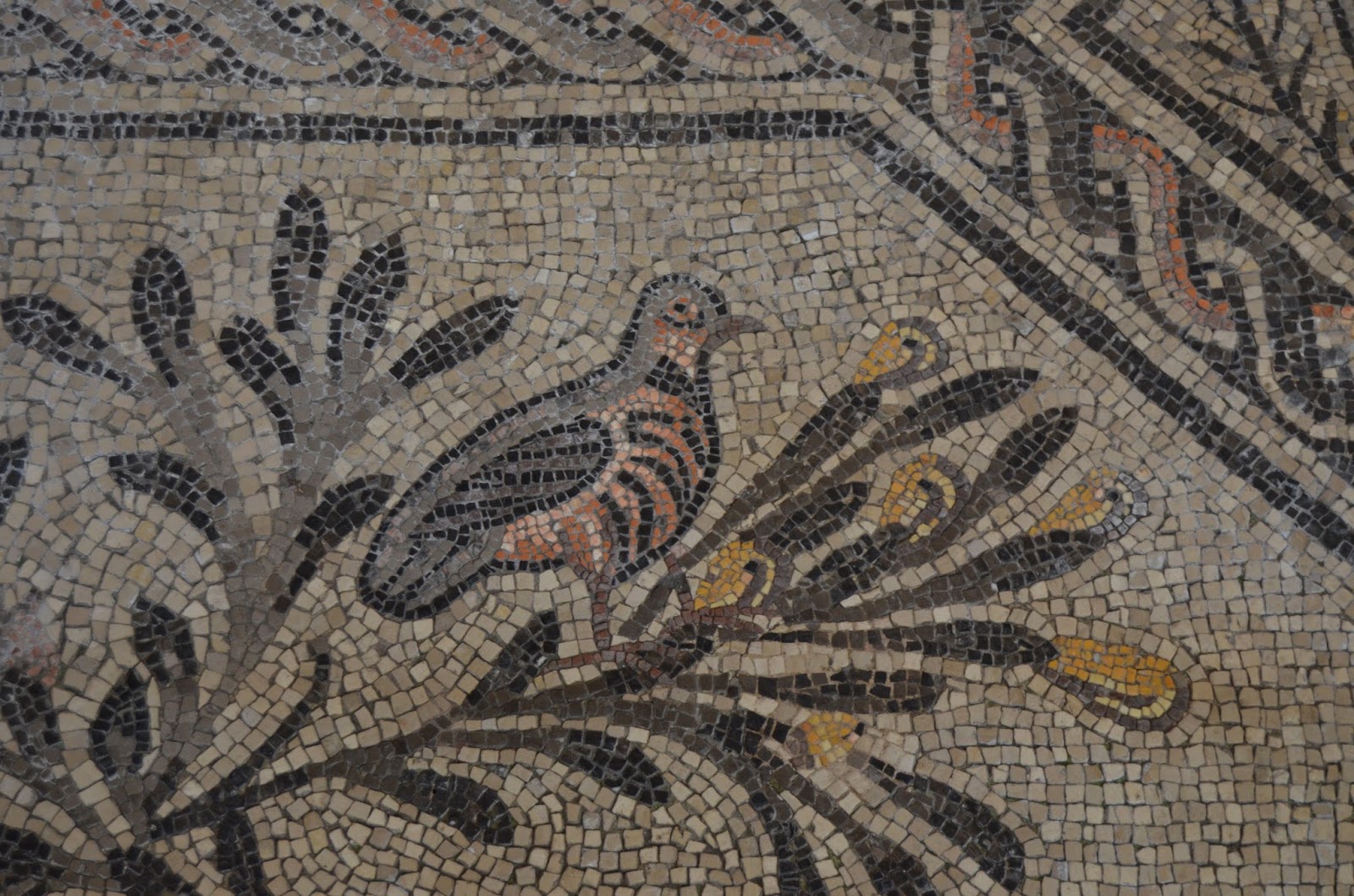
Together with my mom and brother we decided to do a day trip to Aquileia and the nearby town of Grado so we got in the car and drove for 1 hour and 50 minutes and reached the first destination. Right before reaching the town of Aquileia we decided to have lunch at a restaurant called All'Anfora where I had some pasta with seafood. We then parked the car in town and headed on foot towards the Basilica, there we bought the combined ticket (9eur reduced) and entered the Baptistery first. The building is connected to the Basilica through a hall that leads to the center of the Baptistery with the baptismal font at its center; the Baptistery was rebuilt thrice and lost its cupola in the 18th century so now the roof is replaced by some brownish cloths that create an evocative atmosphere. Next to the Baptistery is a building called the Aula Cromaziana, or Sudhalle, which was a hall built by the Bishop Cromazio at the end of the 4th century which still hods an interesting mosaic representing animals such as sheep, goats, and even a peacock. From there we entered the actual Basilica building; the first church was built at the beginning of the 4th century and was later reconstructed four times while the present building dates to the 11th century. Once inside we marveled at the immense and amazing floor mosaic, considered to be the largest early christian mosaic in the world, and being it a Unesco world heritage site and so important it is covered by a glass floor on which to walk on. Throughout the floor there are several stories told through the mosaics, such as the fight between the tortoise and the rooster, the shepherd and the flock, and then many other figures such as fishermen, benefactors, and many different fish. Along the sides are the 5th century columns, on top the 15th century ceiling, and far to the end the apse with a 11th century fresco with Mary and some saints. Below the apse, a 9th century crypt with 12th century frescoes with stories of Saint Ermagora and others of Christ. On the northern side of the Basilica, below the bell tower, is an area with several layers of archaeological remains from different periods. Mosaics of a roman house from the 1st century, and then several splendid mosaics from the 4th century detailing animals such as a lobster on a tree, a plate of snails, another with the rooster against the tortoise, and several birds. We then started our ascension of the 11th century bell tower, that had a well kept mosaic on the ground floor; reaching the top after 73m and 126 steps we had an incredible view of the surrounding landscape with the peaks of the mountains still full of snow. After exiting the tower, we then walked along the old roman road that passed through the old roman river port sided by beautiful trees and countryside. We then turned around and passed through the roman forum with some columns still standing. Further on another open air archaeological area with roman houses and oratories which were used as private altars of the local families. After that we entered the National Archaeological Museum, with several objects of the daily life of the ancient roman population of Aquileia such as glassware, coins, utensil etc. In the gardens of the museum were displayed, though quite dusty and abandoned, some really interesting mosaics depicting different scenes such as one with Clymene a river nymph. 
From Aquileia we drove onwards, crossing the lagoon, and reaching the town of Grado. The town is considered to be the first Venice, as it was the first place the roman refugees sought out after the invasion of Attila. We parked the car and continued on foot, passing through its small and lovely streets which reminded me much of the lesser known parts of Venice. We reached the small main square, called Campo dei Patriarchi, with the two important Basilica's on either side, We first entered the Basilica of Saint Eufemia, that used to be a Cathedral before the suppression of the Grado Patriarchate, the church was built in the 6th century with a 5th century Baptistery, and a 15th century bell tower. Inside it has many roman columns, a 13th century moorish styled pulpit, and an amazing floor mosaic dating to the 6th century with human and animal figures. Next was the Basilica of Santa Maria delle Grazie, also dating to the 6th century, with a empty yet beautiful interior with roman columns and floor mosaic. Walking on through the town we passed by the remains of a third Basilica, also dating to the 6th century, with only a few pieces of wall remaining and some parts of the floor mosaic. We then walked along the seafront and ended the night with a nice dinner with fish and seafood. 
The Basilica of Aquileia 
The Baptistery

Mosaic of a peacock

Interior of the Basilica

Mosaic of the Rooster and the Tortoise

Detail of the mosaic

A bird part of the mosaic

Mosaic of fishermen and different kinds of fish

The crypt with frescoes

Another view of the interior

Mosaic of a plate full of snails

View of the bell tower across the vineyard

The roman Forum

Interior of the bell tower

View of the Alps from the bell tower

Mosaic of Clymene in the National Archaeological Museum

Interior of the Basilica of Santa Maria delle Grazie in Grado

The Campo dei Patriarchi and the Basilica of Saint Eufemia in Grado

Interior of Sant Eufemia

The mosaic inside Sant Eufemia

One of the lovely streets of Grado

Thursday, May 19, 2016

Ravenna (09/04/2016)

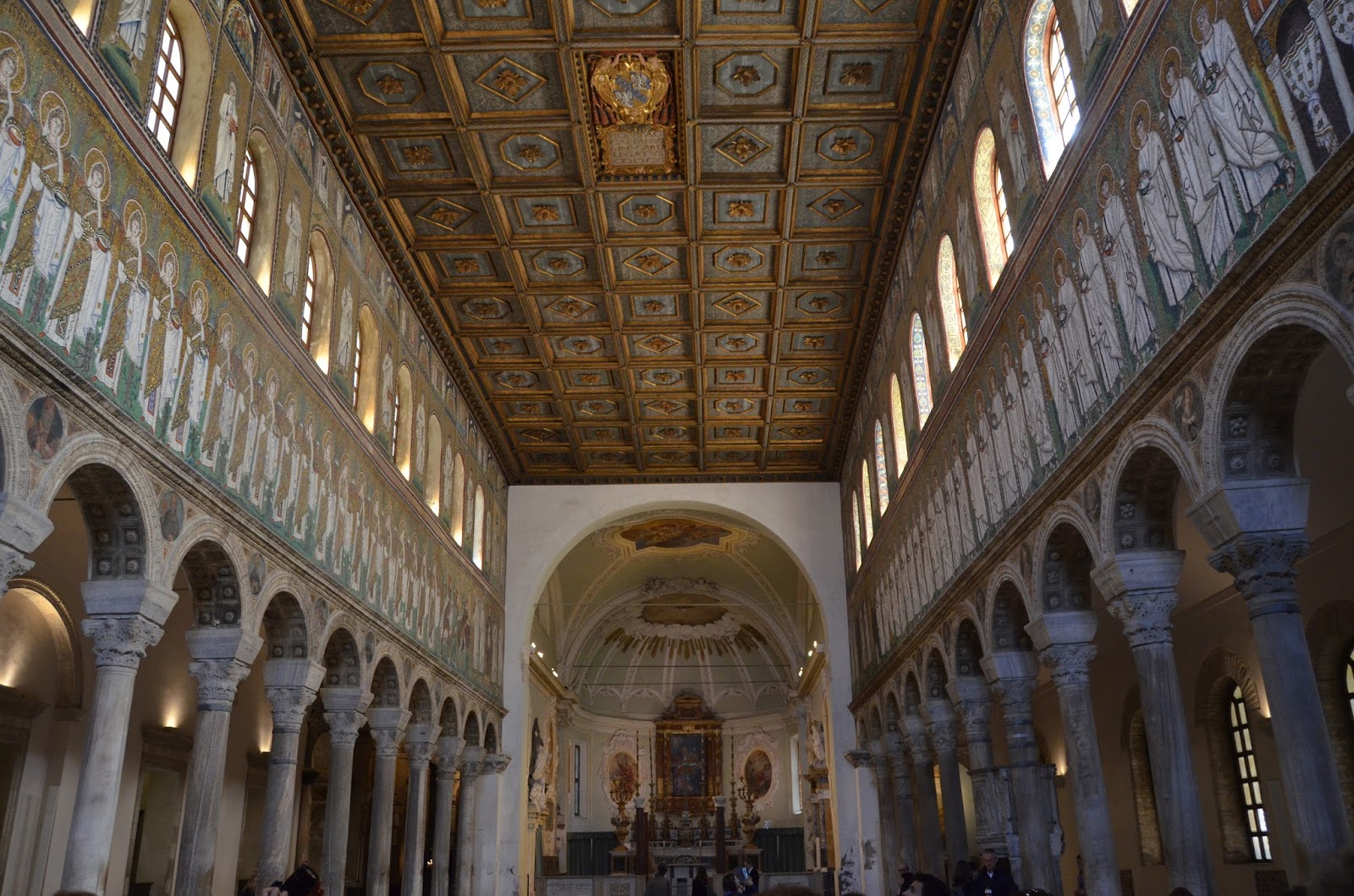
Thanks to my friend Mauro, I was able to participate with his university class in a trip to Ravenna. I was also lucky as the teacher accompanying us was one of the major experts on mosaics in the whole of Italy. So after reaching Mestre I got on the bus and headed south reaching Ravenna 2 hours later. We started our visit with the Church of San Giovanni Evangelista, considered as the oldest church in town and first built at the beginning of the 5th century. It was later reconstructed in the 13th-14th in the Gothic style as we see it today. The main entrance has a beautiful Gothic portal that leads into a small courtyard where the actual church entrance is located. Inside the building, which was unfortunately heavily bombed in 1944, there are still many roman columns with beautiful decorations, but most importantly there are all along the sides some really amazing and well made mosaics dating from 1216 that depict scenes from the 4th crusade. After heading out we directed ourselves to the Basilica of Sant'Apollinare Nuovo, first built at the beginning of the 6th century by the king of the Ostrogoths; Theoderic. Inside the building the two main sides are completely covered in mosaics, the largest mosaic area in the world, dating from different periods. In fact the upper part was built during Theoderic's reign and the figures are more natural looking, like those in the early roman times. The lower part was decorated when the Byzantine Emperor Justinian I reconquered Ravenna, and the figures as in byzantine tradition look more simple and still. On the right side is a procession of Saints leaving the Palace built by Theoderic and heading towards Christ, and on the left one another procession of Virgins lead by the Three Magi leaving the Port of Classis, the ancient port of Ravenna, and heading towards the Madonna and Child. It's quite interesting to note how on the mosaic depicting the Palace there used to be figures of people, noticed by some hands still remaining on the columns, which were later eliminated during Justinian's reign since they were believed to be heretic depictions. Exiting the church we decided it was time for lunch so together with the group we went to a place called Ca' de Ven where we all had Piadina, a flatbread typical of this region, with burrata, a type of creamy mozzarella, and some ham cuts; very tasty! obviously all accompanied by a good red wine. After lunch it was time to get back to visiting. so we headed to the next monument; the Mausoleum of Galla Placidia. Built around 425 it was first built as the private burial grounds for the Empress Galla Placidia who died and was buried in Rome and thus wasn't able to use it. The building is very small and has a latin cross plan with clear byzantine influences. The atmosphere inside is clearly magical, as the place is very dark but is fully covered in mosaics while light enters through small alabaster windows and the decorated central dome with bright yellow stars on a blue background give the impression of a mystical place. There are also two very important mosaics, one depicting Christ as the Good Shepherd, and the other probably depicting Saint Lawrence. Right next to the Mausoleum is the impressive Basilica of San Vitale built in the 6th century. Built in a rare octagonal plan, it used to be fully covered in mosaics which now only remain in the presbytery while the rest is still quite nice to see as the main dome is covered in a splendid 18th century frescoe and the rest of the church is decorated with impressive marbles and floor mosaics. The presbytery mosaics depict several stories such as that of Abraham and Melchizedek, and the Sacrifice of Isaac; the story of Moses and the Burning Bush, Jeremiah and Isaiah, representatives of the twelve tribes of Israel, and the story of Abel and Cain. There are also two really famous and important mosaics; one depicting Emperor Justinian I, clad in imperial purple, with a halo above his head to symbolize his power over church and state and the other one depicting Empress Theodora also with a halo, purple dress and crown and jewels. We walked on and then reached the Baptistry of Neon, which stands right next to the Cathedral. Built around the 5th century, it is also known as the Orthodox Baptistry to distinguish it from the Arian one on the other side of town. The vaulted dome has a beautiful mosaic from the 6th century depicting John the Baptist baptizing Jesus (depicted with a beard) in the Jordan river. All around are the 12 Apostles in white garments and below the mosaics are some really nice marbles with the baptismal font at the center of the building. Right next to the Cathedral we also went to see the Archiepiscopal Museum that had some truly great religious art including a magnificent Throne of Maximian made of ivory and carved in the 6th century. But most impressive was the small inside Chapel built at the end of the 5th century and dedicated to St Andrew with more impressive roman mosaics. Very interesting is the mosaic depicting Christ as a warrior, with the cross on his shoulder, in the act of vanquishing the beasts of heresy; Arianism. After a bit of walking and passing through the city's main square; Piazza del Popolo, we reached the Arian Baptistry. Built around 100 years after the other one, so around the end of the 5th century, it was used by the Arian part of the population. It holds another impressive mosaic depicting John the Baptist baptizing Jesus (who is here beardless as typical in Arian style) and an old man dressed in green who is supposed to represent the river Jordan; all around are the 12 Apostles. It was then time for our last stop: the Basilica of Sant'Apollinare in Classe built in the 6th century, which sits south of Ravenna and used to be the main church of the Port of Classe. The structure is that of a typical basilica with a main nave and two aisles separated by greek columns with capitals in the form of acanthus leaves. It was probably once fully covered in mosaics, though now only the main apse is. However the remaining mosaic is quite amazing and represents several figures: at the top a huge cross on a starry field, on top of which comes out a hand symbol of God, below is Saint Apollinaris surround by lambs symbolizing the faithful and praying to God. All around the church sides stand some really interesting roman sarcophagi. After this church we were all done with our wonderful trip, and getting back on the bus we headed back to Mestre where I eventually took a train back home clearly satisfied in seeing some amazing mosaics and churches all inscribed in the Unesco World Heritage List. 

One of the mosaics inside the Basilica San Giovanni Evangelista depicting the events of the 4th Crusade

The interior of Sant'Apollinare Nuovo

Mosaic depicting Theoderic's Palace

Mosaic depicting the Virgins inside Sant'Apollinare Nuovo

The Mausoleum of Galla Placidia

Monogram of Christ inside the Mausoleum

Mosaic supposedly depicting Saint Lawrence

The beautiful starry dome of the Mausoleum

The mosaics of the Basilica of San Vitale

The frescoed dome of San Vitale

The mosaics of San Vitale

Mosaic depicting Emperor Justinian I

Mosaic depicting Empress Theodora

The Arian Baptistry

View of the Basilica of Sant'Apollinare in Classe

Mosaic of the apse

Wednesday, December 30, 2015

Trip around eastern Veneto (15/07/2015)

I left Jesolo, the beach town where I have a summer house, around 9;40 with my car and reached my first stop, the archaeological site of Altino about 20-25 minutes later. Once a flourishing and important roman city, it was sacked and destroyed by the invading barbarians and then slowly abandoned for a more safer area in the middle of the lagoon which turned into what is now Venice. So after parking the car I went to the museum's entrance but found a note saying to head on 300m where the new museum had been built. So I took some pictures of the roman tombs sitting outside in the old museum's courtyard and drove on to the new location. The new building in fact looked very new and large, once inside I asked the lady for a student discount, and she told me that since the museum was not fully complete yet the fee was 1,50€. I must say though that even if not complete yet, it is not a really nice museum, some displays were empty and the descriptions in general were a bit too long an boring. There were some nice artifacts on display but in general not so interesting. Hopefully in the near future they will finish the displays and present it in a more interesting manner so as to attract more tourists. So after the visit I got back in the car and headed for my next stop: Roncade. The main future of this little town is an impressive 15th century villa surrounded by a massive wall with towers, and behind it vineyards since it now works as a wine producing estate. Once inside I saw there was a possibility to have a tour of the place (for 10€) but I had to wait till the next one which was at 3:30pm so I decided to just see the garden and the outside by myself. After taking a few pics I was back in the car and heading for the next stop: Oderzo. This little town used to be a major roman city which once reached 50.000 inhabitants, however after the barbarian invasions it never recovered. Only during the middle ages and then under the Venetian Republic did it gain again a relative importance, though now it barely reaches 20.000 inhabitants. Once I reached the town, I parked my car right outside the city center and started walking around; unfortunately there was a market set along the streets so all the palaces were covered. I saw though that some were beginning to pack up so I decided to look for a place to eat while I waited. I found a nice restaurant just behind the Duomo, where I ate some really good strozzapreti (type of pasta) with 4 cheeses. After lunch I was happy to see the market was gone and so I was able to take some nice photos of the wonderful palaces of the old town. I then headed to the tourist office where I was given a map that detailed the many roman remains that dotted the town all over, I walked along the streets seeing mosaics, remains of villas and the remains of the roman forum. I then headed for the town's main square: Piazza Grande, with the nice romanesque-gothic Duomo, the Torresin or clock tower and several palaces. From there I walked back towards the car and stopped at the city's archaeological museum, which was quite small but had some 2 or 3 beautiful roman mosaics and some roman tombs and inscriptions. The video which showed the virtual reconstruction of the forum and a roman villa was very nicely done. Entrance fee to the museum was 3€. Heading on the next destination I decided to stop right before Portogruaro to check out the Abbey of Summaga, a nice Romanesque church built in the 13th century with frescoes of the same period detailing Mary and the Apostles. Since I was the only one there I was free to walk around without anyone bothering me. From there I got back in the car and entered the town of Portogruaro. I parked right outside the old city center and started the visit with a church right next to the parking lot, the Church of St Agnes. Then passig through the southern medieval gate I reached the old part of the town. A road heading north was lined on both sides with beautiful palaces, venetian styled and mostly gothic. I then walked on and entered the Museo Nazionale Concordiese, an archaeological museum depicting the roman findings of the nearby city of Concordia Sagittaria. It is thought to be the oldest museum in the Veneto region and one of the oldest in Italy. Ticket cost was 1,5€ with student discount. I thought the museum was quite small and a bit too full of objects, in fact most of the objects are cramped in the main room and are set up all around, like they did in older museums during the 1800s. Thus one can be distracted by all the things and cannot concentrate on one single piece at a time. Also the descriptions are a bit too small and not easy to read. Heading out of the museum I reached the tiny park located on the shore of the Lemene river, where there is a beautiful view of the back of the cathedral and a small square behind the city hall. There are also two really old watermills, perfectly preserved dating from the 12th century. I then crossed a bridge and reached the eastern part of the town, where the northern medieval gate was located. I then headed south along another road, parallel to the river like the one i previously walked on the other side, also filled with splendid palaces. I reached the Cathedral and went inside; rebuilt in the late 18th century and beginning of the 19th in a neoclassical style it doesn't feature anything important and the façade is incomplete; the bell tower is the only remaining part from the previous church. Close to the church is the city's main square: Piazza della Repubblica, with the wonderful gothic civic hall dating from the 13th century at its center. Behind it a small square overlooking the river with the old medieval fish market also in the gothic style. I then walked further on, passing through another medieval gate, and saw one last church before getting in the car: the church of St John. I reached the small town of Concordia Sagittaria, another once important roman town in the area. Once there I parked the car and entered the Cathedral, dating from the 15th century it is built over a few other Cathedrals that existed before, the most notable of which and also the first built in 350 A.D. Inside were a few remaining frescoes from the medieval times; I then headed out and entered the amazing Baptistery, built in the 11th century in a byzantine style and featuring frescoes detailing stories from the Bible and saints. It was then time to go so I got back in the car and back towards Jesolo, happy of having spent a day off from the beach.

The Castle of Roncade

Walls of the Castle of Roncade

Roman mosaic in Oderzo

View of the Duomo and square in Oderzo

One of the streets in Oderzo

Roman mosaic in the archaeological museum of Oderzo

Frescoes in the Abbey of Summaga

Inside of the Abbey of Summaga

View of the Abbey of Summaga

Southern entrance to Portogruaro

Inside of the museum in Portogruaro

View of the watermills, old fish market and Duomo in Portogruaro

Street in Portogruaro

View of the old mills

The main square and civic hall of Portogruaro

The Lemene river

Another street in Portogruaro

Cathedral of Concordia Sagittaria

Baptistery of Concordia Sagittaria

Frescoes inside the Baptistery