Showing posts with label Emilia Romagna. Show all posts

Sunday, July 28, 2019

Bologna (20/12/2018)

After coming back from Hamburg to Vicenza for the Christmas holidays, I decided to do a day trip and visit the city of Bologna which I hadn't seen in so many years. So after finding a super cheap deal with a bus company called Marino I booked the ticket for both ways costing me just 10 euros in total. The bus left the station in Vicenza in the early morning so that gave me plenty of time to explore Bologna. After reaching the city's bus station three hours later I headed towards the city center and immediately stopped to have a look through a small window set inside a wall. As I opened the window I was able to have a look at one of the many canals that used to flow through the city. This canal called Canale delle Moline is one of the few that managed to survive the coverings that took place between the 1930s and 50s. Along it, in the past, the washerwomen would stand on wooden boards and wash their clothes there. A little further on I then reached the church of San Martino, which despite being under reconstruction was still open; I thus decided to head in and visit it. Built during the 13th century it was refurbished the following three centuries in a mostly Gothic style. The interior held some nice features such as the remains of a 15th-century fresco by the famous painter Paolo Uccello. After that, I headed back out through the streets and reached the Basilica of San Giacomo Maggiore not much further on. A beautiful mix of Romanesque and Gothic, the church was built around 1267 and just slightly modified the following centuries, mostly in its interior. After entering the building a priest that had been sitting down on the benches came up to me and started discussing a bit about the Augustinian order, which manages the church, and about God and religion in general. After a long monologue, he finally let me go and I was able to tour the interior of the basilica which featured a mainly renaissance structure with Baroque additions. In the far back of the church, next to the apse and main altar is a beautiful renaissance chapel belonging to the Bentivoglio family with incredible frescoes. The entrance was barred, as it can only be visited during the weekend, but one could see the whole structure from the outside. It was quite dark though and a coin was necessary to illuminate the frescoes, which I opted not to do and just see it through the natural light. After exiting the church and walking right behind the apse a small door led to a large room where a lady asked me if I wished to buy the ticket to see the Oratory of Saint Cecilia. After paying the small fee the lady gave me a plaque and briefly described the structure before letting me tour around myself. Known as Bologna's Sistine Chapel, it features a beautiful array of early 16th century frescoes by local artists with stories of Saints Cecilia and Valeriano. Even though photography was not allowed, I nonetheless managed to take a few pics of the beautiful frescoes. As I exited the oratory I continued walked and passed by a section of street flanked by huge porticoes. Bologna is in fact known for its porticoes which put together form 38km in just the city center and up to 53 if counting the outer areas too. They are a typical feature of Italy and even more of the city of Bologna and in fact, there is no other city in the world with that amount with Torin coming in second place with "just" 18km. After walking under such an interesting structure I reached the triangular-shaped square, Piazza Santo Stefano. One of the most pretty and characteristic of the city center, it features a large basilica on the shortest side, Basilica of Santo Stefano, which gave the name to the square. Also known as the seven churches, it is called so due to being made up of several small churches and chapels which together form up a continuous structure. Having really ancient origins, it is thought to have been built during the 5th century upon a temple dedicated to Isis in order to recreate the church of the holy sepulcher of Jerusalem. As I entered, I first passed through the main part which consisted the church of the holy crucifix built as a single nave originally dating to the 8th century but with a 17th-century altar featuring a crucifix from 1380. A small door then led to an octagonal structure called the church of the holy sepulcher, originally built during the 5th century but rebuilt during the 11th century after the Magyar invasions. The octagonal building holds a marble structure at its center which was supposed to represent that of the tomb of Jesus in Jerusalem. Another door led to another church, that of Saints Vitale and Agricola. Considered as the oldest of the complex, it features a plain nave with reutilized roman columns supporting the structure. Due to the upcoming Christmas festivities, they had set up a nice nativity scene all along the central nave. Moving onwards I then reached the Courtyard of Pilate, with at the center an 8th-century longobard basin and bordered by romanesque portals to the south and north, the former leading to the church of the holy sepulcher and the latter to the church of the trinity which I then proceeded through. A small arcaded structure it was meant to become a larger church but was never finished and instead turned into a baptistry featuring still some 14th-century frescoes. A door then led to the cloister, a beautiful large Romanesque structure dating to the 12th century with a nice renaissance well at its center. Along its eastern end are a series of small rooms which now feature a small pretty museum with gothic works of art. After the visit of the incredible complex, I then headed further and reached the large Piazza San Domenico. Named so because of the large Basilica which stands at its southern side, it hosts some interesting monuments as well. There are two columns, one holding Saint Domenico and another holding the statue of Mary and built in 1632 to commemorate the end of a plague which had hit the city. There are also two free-standing tombs in the form of a baldachin which were built during the 14th century as resting places for two law professors and jurists. One for Rolandino dei Passaggeri and the other for Egidio Foscherari, they are topped with a green pyramid-like structure supported by columns. As I admired the monuments I then decided to enter the Basilica, originally built during the 13th century but which suffered various refurbishments. The interior, in fact, presented a typical Baroque style dating from the 18th century but with some earlier features such as the outstanding Arca di San Domenico, an impressive monument holding the remains of Saint Dominic. Built by the famous sculptor, Nicola Pisano in 1267, with the help of his apprentice Arnolfo di Cambio, who would then become famous as well, it then received further additions, one of which during the 15th century by the then young Michelangelo. I then went out through a door and walked around the small yet pretty cloister which granted a view of the southern part of the basilica that was still surrounded by a bit of snow that had not yet melted away. After seeing the church I then headed back out and walked until I reached the building of the Archiginnasio, the city's university main building. The University of Bologna is, in fact, the world's oldest having been founded in 1088. The Archiginnasio was built a few centuries after, around the 16th century, and became then the main seat of the university. As I walked through its courtyard I noticed the beautiful coat of arms of all students coming from all over the then known world. Students were in fact organized as groups from the same nations or area and it was interesting to spot those from all over Europe on the building's walls. As I walked upstairs I then reached a long hallway which led on one side to the university library, currently used by students, and on the other to the 17th-century anatomical theatre used to show medical operations to students. As the entrance to it required a ticket I decided to skip for this time and head further to explore the city. From there it was a really short walk to reach the central square, Piazza Maggiore. As I entered from the south-eastern side I walked by the renaissance Palazzo dei Banchi on the right, and the Basilica of San Petronio on the left. Then right in front was the 13th century Palazzo del Podestà, where the governor of the city used to reside, while the western end of the square was flanked by the 14th century Palazzo dei Notai and the 14th century Palazzo d'Accursi, also known as Palazzo Comunale, as it served as the seat of the city's administration and still serves as city hall today. I then decided to head to visit the church after admiring its incomplete yet impressive facade. Originally built during the 14th century, an incredible marble facade was planned with just the bottom half being completed during the 16th century. The upper half was left with the bare brick making it a sharp contrast with the elegant lower part. After entering the building I walked through its immense nave featuring a typical Gothic structure. The church is, in fact, the largest brick gothic church in the world measuring 132 meters long, 66 wide and 47 tall. Photography was strangely not allowed and a part was closed off for those not possessing a ticket. After admiring the interior I then headed back out to the square and through another smaller square, the Piazza del Nettuno, which was basically a continuation of the main one to the north. At its center stands the beautiful Fountain of Neptune, a monumental civic fountain constructed in 1567 by the architect Giambologna. As in other cities around Italy, the figure of Neptune, God of the sea, is a prominent feature particularly due to the nature of the fountain as a dispenser of water. Back through the main square I then walked under Palazzo dei Banchi to reach a dense area of the city. This used to be one of the main commercial areas of the city and where the labor corporations used to practice their trades. Now after so many centuries its destination has not changed much and it is the area known as Mercato Vecchio or old market. All kinds of food shops found a place here from small family-owned enterprises showcasing beautiful and moth watering hams, cheeses and so forth to the larger and more known international markets like Eataly. After admiring all kinds of local specialties I decided to stop at one of the small shops/restaurants and try a mortadella-filled sandwich. After having lunch and feeling satisfied I then continued my walk through the city, passing by two medieval towers. These two towers, the Torre degli Asinelli, and the Torre della Garisenda are two famous attractions of the city. The city used to be in fact once filled with towers, reaching a grand total of 150 just in the city center, and these two towers are just a small reminder of that grandeur. Both leaning sideways, with the Asinelli by 2.2m and the Garisenda by 3.2, they are impressive to look at. The former reaches a height of 97.2m making it the tallest leaning tower in Italy. As I continued on I then reached and entered the National Art Gallery, one of the leading art museums in the city. Mostly centered on Emilian artists from the 13th to the 18th centuries, it also features works of art of other artists which in some way influenced or were influenced by the city. Among the many medieval altarpieces and frescoes, and the 15th and 16th-century paintings were also examples of famous artists such as Giotto, Titian, Parmigianino, and Raphael. After touring the museum for a bit I then walked back through the city center passing once more by the main square and ending up in a small square, sided by the late mannerist church of San Salvatore and a building which had a plaque indicating that was the birthplace of Guglielmo Marconi, the inventor of the radio. As I walked further I then reached the impressive Basilica of Saint Francis, located on the western end of the old town. Right behind its apse, on a small garden, where three more examples of free-standing tombs with the typical green pyramid structure this time dedicated to three other law professors and jurists from the 13th century, Odofredo Denari, Rolandino dei Romanzi, and Accursio. Passing by the tombs I then entered the church and visited its large interior, which being built around the 13th century, presents a Gothic structure but more like the french style thus making it one of its best examples in Italy. A beautiful marble altar from the 14th century stands above the main altar. After seeing the interior I went out from the front and turned around to admire the facade which still fitting well with the rest of the church actually presents a Romanesque style. The sun was starting to set and it was time for me to head back to the bus station from where I took my ride that took me back home in Vicenza.

The paintings in the Oratory of Saint Cecilia

A typical street with the porticoes

A medieval street

The Basilica of Santo Stefano

The nativity scene inside San Vitale and Agricola

The interior of the Holy Sepulchre


The courtyard of Pilate

Turtle painting

The 14th century tomb of Rolandino dei Passaggeri 

The Arca di San Domenico

View of the Basilica of San Domenico

The coat of arms of the students of the university

The Archiginnasio

The Piazza Maggiore with the Palazzo dei Banchi on the right and the Palazzo del Podestà in front

The Basilica of San Petronio

The Fountain of Neptune

A typical food shop

The two towers

The Torre degli Asinelli on the left and della Garisenda on the right

View of the Basilica of San Giacomo Maggiore

A painting in the National Gallery

The facade of the Basilica of Saint Francis

The Palazzo del Podestà and a christmas tree

View of the Torre degli Asinelli


Saturday, July 13, 2019

Ferrara (25/09/2018)

After finding out that there was a cheap bus by the company Marino bus from Vicenza to Ferrara I did not hesitate in taking the chance to see this city which I always managed to postpone visiting. After taking the early ride from the bus station I reached the destination 2 hours later. After heading towards the old town, which is extremely large, I passed by the Church of San Domenico, finding out only once in front of it that it was closed still due to the earthquake which had hit the area in 2012. I continued on and walked through Piazza del Municipio, a small square which used to be the courtyard of the Palazzo Municipale, one of the first ducal residences of the house of Este. Built during the 13th century the main facade on the other side, facing the Piazza Trento e Trieste is from that period while the rest was refurbished during the 15th century including the Scalone d'Onore built in 1481 as a majestic entrance staircase. The palace now serves as the city town hall and faces the Cathedral which I then proceeded to visit. Built during the 12th century it features a beautiful Romanesque white marble structure while the interior was highly refurbished during the 17th century in the Baroque style. Unfortunately, the facade which was the epitome of the Romanesque part of the complex was covered in scaffolding due to ongoing restructuring. I was a bit upset but nonetheless decided to at least see the inside. As mentioned, the interior was a fully Baroque style, made after a fire which damaged the earlier structure in the 18th century. After visiting the cathedral I then decided to walk further and walked along a street called Via delle Volte. This medieval street used to be a typical feature of the city and only this one has survived intact through history. As its name suggests it consists of a tight alley which features several arched buildings covering the street along the way. After reaching the end of the street I then walked a little further and eventually arrived at the Monastery of Sant'Antonio in Polesine set in the southeastern end of town right by the city walls. It is a very ancient church, built during the middle ages by Augustinian Hermits on an island surrounded by the Po river. As time passed and the city of Ferrara grew the river was moved north and thus the monastery came into the city limits. The present structure of the building is from the 17th century and in a Baroque style with several features from its earlier times. Access inside was not simple, I luckily arrived at the right time, in fact, I was supposed to ring a bell and wait. A nun then came to open and I asked if I could visit the church's interior; she agreed and then led me to the monument. She gave me a tour of the church and of the amazing frescoes of the school of Giotto, made around the 14th and 15th centuries. Stories from Jesus' young age and his passion stood alongside other less religious ones which were becoming quite in vogue in that period. As the nun spoke the bell rang again so she left me alone for a little bit while she checked who had arrived. I took the chance then to admire the frescoes closely and take lots of pics, which I assumed was forbidden as they would probably wish to sell their postcards and gadgets instead. After the old nun came back, she finished the explanation and then let me exit outside of the monastery. From there I headed through some streets and reached the church of Santa Maria in Vado, dating to the 15th and 16th centuries. Inside is a beautiful mix of Renaissance and Baroque style with lavish marbles and colorful paintings. The church is also an important pilgrimage site due to a Eucharistic miracle which occurred in 1171 when the blood spurted from the host during mass. I also had a look at the Renaissance cloister which held the typical form of the arches so common in this area. After that I then headed north and reached Casa Romei, a 15th-century palace holding a museum. The palace was built by a merchant who married into the Este family and was able to transform his residence into a lavish mansion. The museum, in fact, consisted of the palace's rooms, several of which with most of the original decorations and frescoes, with some archaeological and medieval objects on display. I enjoyed admiring the interesting mix between Gothic and Renaissance structures and features. After the visit to the museum, not far ahead, I then entered the Basilica of San Francesco, also receiving some renovations due to the earthquake, it was partly open and I could admire the nice Baroque interior. From there I then continued on and after a bit of walking reached the Palazzo dei Diamanti, built at the end of the 15th century and one of the most celebrated examples of Renaissance palaces all over the world. It is noteworthy for its peculiar form consisting of an exterior wall made of some eight thousand white and pink marble blocks in the form of diamonds, hence its name. The palace was part of a larger urban design which took place around 1492 when, due to the growth of the city, Duke Ercole I d'Este had the architect Biagio Rossetti redesign the whole area to the north of the city. The medieval walls were torn down and planned buildings and streets were laid out following geometric lines, a Renaissance novelty compared to the intricate streets of the middle ages. This plan was celebrated as the so-called Addizione Erculea, from the duke's name, as used as an example of urban planning all over Europe. I then decided to enter the palace and visit the National Gallery hosted on one half of the Palace. As I entered, I found out though that large part of the exhibition was closed off due to restructuring and that meant just that just four rooms were open for visits. Nonetheless, the tour was nice and started with a large room consisting of paintings from the 13th and 14th centuries some of which were frescoes from the local church, and then continued on to later paintings from the 15th, 16th and 17th centuries made by local artists. As I finished the tour I then headed back out and walking further reached the Ferrara Charterhouse. As I approach, though, I found out it was also closed due to renovations which meant just admiring its Renaissance structure from the outside. The church was part of a large complex which consisted of the monumental cemetery thus allowing me to circle the church and admire the view. I was starting to get hungry so I decided to head back to the core of the city where I stopped at a small kiosk called Mordicchio which served the typical pancotta, known as piadina in the rest of Italy. I took one with cheese, a local salami, and rucola and took it to go. I walked then again through the medieval Via delle Volte and reached then the National Archaeological Museum. Hosted inside a large and impressive Renaissance palace called Palazzo Costabili, it is considered as one of the city's major attractions. Its large collection of objects comes mainly from the digs of the ancient city of Spina, a very important Etruscan town in the area and a major commercial hub. As I walked through the rooms I admired the many interesting objects, from Greek vases to typical Etruscan bronze jewelry. I also admired the rooms themselves which many still had the original frescoes and decorations from the Renaissance period. The main floor on the second floor also hosted a nice display of old and new maps of the area made during the Fascist period. As I walked back down I then visited probably the most beautiful room in the palace: the Sala del Tesoro, as it is known. The ceiling features a beautiful and impressive trompe-l'oeil from 1506 and painted with extreme detail and wonderful colors. Right next to it, another room contained, in a dark setting, the remains of two well-preserved pirogues dating to the 4th century B.C. As I then walked through the palace's gardens I met two Brazilian ladies who were surprised in hearing me speak Portuguese so well and asked a bit about the city and the surroundings as they were just passing by. I told them it was a very nice city and luckily devoid of nearly any tourists, particularly at this time of the year. After finishing to visit the museum I then headed out and in the direction of the main square. After passing by the Cathedral once again, I reached the impressive Castello Estense, a peculiar medieval castle sitting in the middle of the city and still surrounded by its original moat. Built during the 14th century, it consists of a large fortified central block with four corner towers. As I crossed the drawbridge, I bought the ticket and entered the building. Being it the most famous attraction of the city meant that it was full of tour groups, mostly consisting of old people from the surrounding region, so that meant I had to push through to be able to continue on. The tour started at the ground floor which consisted of four gothic rooms and the kitchens. Then through a narrow corridor, I then continued on and entered the rooms which once served as the castle's dungeons which had seen also important figures of the time imprisoned there too. A stairway then led upstairs to a small terrace known as the Garden of the oranges, because of the fact that as it is nowadays, a group of orange trees was kept here to take advantage of its southernly position. The view from there was also really nice being able to see the square adjoining the Palazzo Municipale. Once back inside, I then continued on through more rooms including the Ducal chapel, and other rooms named following their use. These were a big contrast to the spoil and gothic rooms from downstairs as these ones, being on the so-called piano nobile, were used by the Dukes and thus lavishly decorated in the Renaissance style. I then reached a part which enabled one to go up one of the four corner towers, however, that required an extra ticket and that meant pushing my way backward through large groups to reach the ticket office and back up there. I decided to skip as also the last entrance up the tower was closing in the next five minutes. I had toured the whole complex and was happily satisfied with the visit. It was time for me to head back out and to the bus station where I then caught the bus which brought me back home. 


The Piazza Trento e Trieste with the Cathedral and the Palazzo Municipale

One of the streets of the old town


The frescoes of the Monastery of Sant Antonio in Polesine

The church of Santa Maria in Vado

Interior of Casa Romei
The courtyard of Casa Romei

The Palazzo dei Diamanti

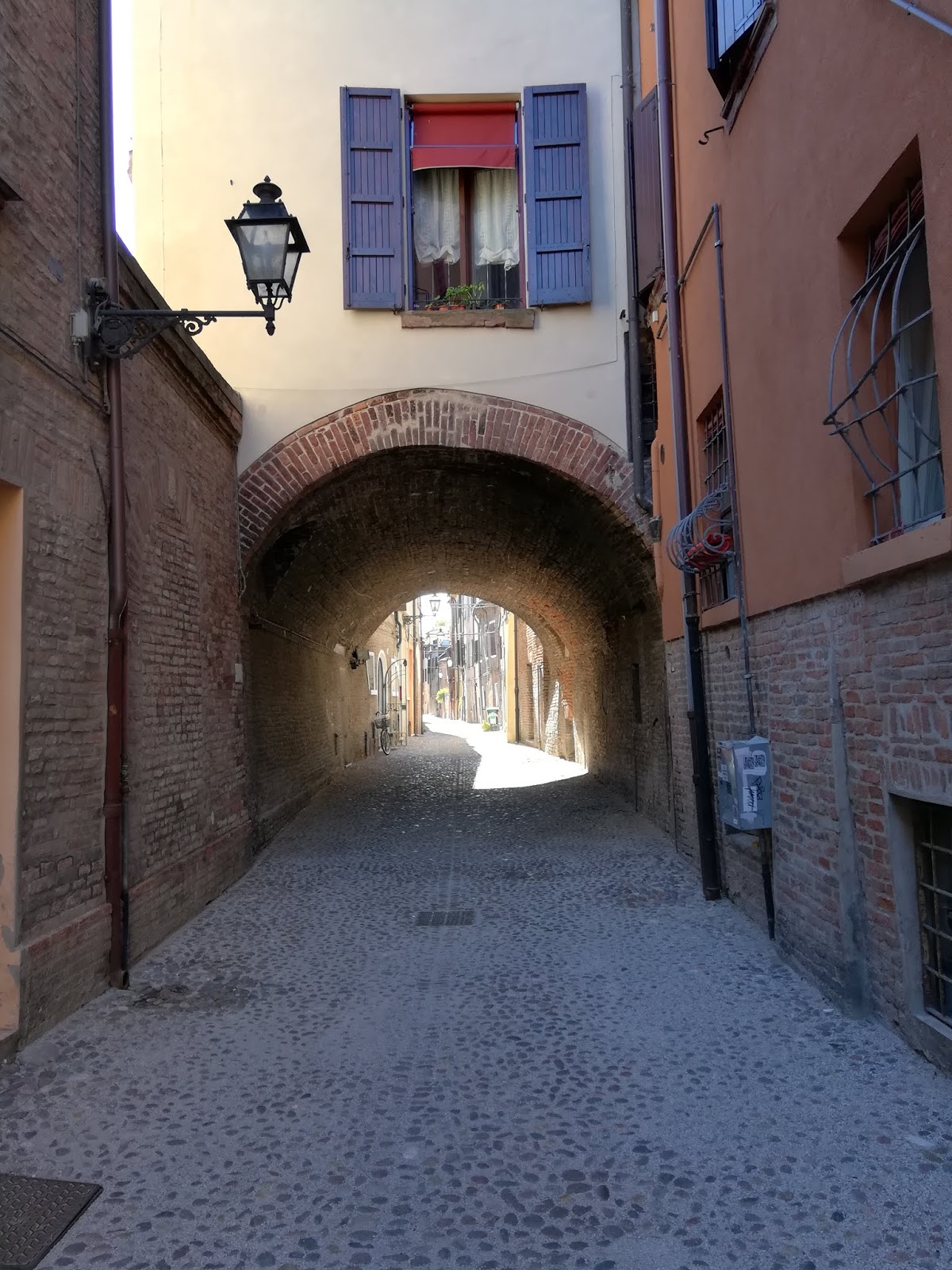
The medieval Via delle Volte

The Palazzo Costabili seat of the National Archaeological Museum

The Sala del tesoro inside the museum

View of the castle

Another view of the castle

The castle's moat

View of the town from castle's garden of the oranges


Tuesday, December 25, 2018

Modena (04/01/2018)

A few days after New Year's my family and I decided to head to the city of Modena in Emilia-Romagna for a day trip. After driving one and a half hours we reached the destination and parked the car right outside the old town. The first we decided to visit was the Cathedral, which was partly under construction. A Unesco world heritage site, the church is considered as one of the most important Romanesque buildings in Europe. Construction of the Cathedral started during the 11th century over the burial place of St Geminianus, now the patron saint of the city, and then consecrated the following century after construction was concluded. A man named Lanfranco was the architect overseeing the construction yet not much else is known about his life. Another man named Wiligelmo came along with a group of people known as the Comacine masters (coming from the town of Como) who were responsible for decorating the Cathedral with reliefs, statues, and decorations. Following them, another group of people, this time from the town of Campione, the Campionese masters, came to complete the bell tower and the interior decorations. After admiring the interior and its decorations and sculptures which make it extremely impressive and artistically important, we then walked around the Piazza Grande, the main square surrounding the Cathedral. We were able to admire the church from the south and the tall impressive bell tower, known as the Ghirlandina, at its northeastern end. On the eastern end of the square is the Palazzo Comunale, a 17th-century palace, now the city hall. At its center stands the clock tower and right in front of the entrance is the so-called Preda Ringadora, a stone probably dating to the roman times which was used during the middle ages as the place for the orators to make announcements or as the public gallows. We then went inside the palace and visited the small museum which included some nicely frescoed rooms and the famous Secchia Rapita, a medieval bucket which was stolen by the Modenese people from a well in the enemy city of Bologna during the battle of Zappolino. After the visit, we then decided to walk a little around town before heading to lunch. We passed through the typical porticoed streets and in front of the Ducal Palace, an impressive 17th-century palace used by the Este family and now serving as the prestigious Italian Military Academy. Further on we passed the hidden and unseemly Fontana d'abisso, a small fountain still used to this day. We started getting hungry so we decided for a place to eat, unfortunately, many were either closed for the holidays or full so we eventually managed to find a spot at a restaurant called Da Enzo. Here I had a really good dish with tortellini filled with pumpkin. After lunch, we then headed for the Palazzo dei Musei, a complex containing several museum including the Estense Library, Estense Gallery, Roman Lapidarium and Civic museum. We decided to visit the Estense Gallery as we did not have time to visit all the complex. The museum was formed around the collection of paintings owned by the Este family, particularly Italian and local paintings ranginging from the 14th to 18th centuries. We saw some really interesting and famous pieces and were happy to have had a free guided tour included in the ticket. After the museum, we had another stroll around town this time admiring it by night as the sun had set during our visit to the gallery. After that, we then headed to our car and drove back home.
One of the decorated capitals inside the Cathedral

The northern portal

The Cathedral facade 
The Piazza Grande with the Cathedral's southern portal and the Palazzo Comunale with the clock tower.


View of the Cathedral with the bell tower from the south.

One of the streets with the typical porticoes of the area.

The Ducal Palace now the Military Academy.

Another street in the old town.

A decorated violin inside the Galleria Estense

View of the main square with the Christmas lights

Monday, August 22, 2016

Pomposa Abbey (25/06/2016)

I decided to spend a weekend visiting my friend Mauro, and staying there for 2 days. We had planned to spend the time at the beach but he insisted I visit Pomposa Abbey, a large monastery located in the province of Ferrara about 30 minutes drive from his house. After parking the car, we went to the ticket office (ticket was 2,50 reduced) which was located in the Palazzo della Ragione across from the church's entrance. We then entered the Refectory, where the monks used to eat, with several nice frescoes remaining particularly nice that depicting the Last Supper. Moving on we entered the small museum, which holds many artifacts belonging to the church, such as frescoes, statues, column heads etc. Next to the museum we peered inside the Chapter House with some nice frescoes depicting Jesus and other saints. Finally we went inside the church itself, which was first built in the 6th century while the building now dates to the 11th century. The main hall was amazing, diving the two side naves were some really nice and interesting columns, and the upper part of the naves, the apse, and the entrance were all decorated with 13th century frescoes. They mostly depicted the Old and New Testament, while the apse depicted Jesus with the Evangelists and the entrance an incredible Last Judgment. Furthermore, the floor was covered in splendid mosaics, in the opus sectile style, with animal and human figures. After walking around inside the church, and admiring the beauty of it, we exited and gave one last look at the imposing 48m high Romanesque bell tower, before getting back in the car headed for the beach.

The Last Supper inside the Refectory

View of the cloister, church and tower

View of the interior
 
View towards the entrance

View of the church and tower from the front