After attending Ania's master defense in Krakow, I decided to visit my brother who had recently started working in Prague. After seeing Ania to the bus station in Krakow, headed to Hamburg, I took a bus in the direction of Brno. As expected my bus was late, and even though I had two hours time to catch my transfer, I was barely able to run from the bus station to the train station once in Brno and manage just in time to catch the last train to Třebíč. After a late arrival, I headed to the accommodation which was a room right above a bar in a not so busy street. The funny thing was the owner, both of the bar and the rooms upstairs was already drunk and fumbled to show me the keys and the place and then going back to serving and drinking with the locals in the bar downstairs. Luckily, the sound was not hearable and nonetheless stopped completely after a while. The following morning, after a good night sleep I left the place and headed out to explore the town. I had chosen it because its Jewish neighborhood and its basilica are inscribed in the Unesco list. So as I headed towards the city center, I first reached a nearby hill where an observation deck granting a great view of the old town. The weather was not the best and several clouds had decided to cover up most of the sky, but that didn't demoralize me from continuing on. From there I walked downhill and reached the aforementioned Jewish neighborhood which comprises a large part of the old town and set on the northern bank of the Jihlava river. As most Jewish areas in Europe, it was set apart from the rest of the city and usually enclosed by a wall which would be closed from dusk till dawn. Specifically, this one is considered as one of the best preserved in Europe having survived quite unscathed throughout history, particularly during the violence of World War 2. Sadly as it went with other places, of the original Jewish inhabitants who were deported to concentration camps only about ten made it back to their houses. As I walked through the old streets I admired the nice architecture and the synagogue which once served the local community and is now a museum. Then continuing on, I reached the other site included in the Unesco list, the Basilica of St Procopius. Originally built during the 13th century and dedicated to the Assumption of the Virgin Mary, it was dedicated to its current saint just in the 18th century. As I approached the monument, I first walked under a nice Baroque gate which marks the entrance to the city's castle to which the basilica is annexed. As I entered the premises I was able to admire the whole structure of the church. Despite the facade and bell towers having been reconstructed in the Baroque form, the rest of the church presented its beautiful original Romanesque/Gothic structure. In fact, as I visited its interior, I marveled at the huge main nave and the elegant arches leading up to the vaulted dome. One of the side chapels also contained some well-preserved traces of medieval frescoes representing religious scenes. After visiting the interior, I then headed out and made a circle of the structure, passing through a nice botanical garden set behind the church's apse. As I still had time to spare and it was not too far of a walk I decided to head out of the town and see the Jewish cemetery. Once I reached the place, the gate was unlocked so I decided to head and walk among the graves of a once large community that inhabited the city. It was well maintained which meant that, despite the change of community, those who had died were not forgotten. Then, once back in the old town, I walked through the core of the city, represented by the Karlovo Namesti, the main square. At its southwestern end, I passed by a nicely painted house and then slightly uphill reached the church of St Martin with a nice Baroque interior. At that point, I directed myself to the bus station from where I took a ride to the next town: Telč. As I reached the destination I immediately headed towards the old town which was located close by. Founded in the 13th century as a royal water fort on busy merchant routes it is in fact sided to the north and south by two lakes. It is also a Unesco world heritage site since 1992 due to its impressive old town. As I approached, in fact, I entered the immense main square, which occupies nearly the whole city center, and marveled at the perimeter beautifully lined with multicolor Renaissance and Baroque houses with high gables and arcades. At the center, a plague column and a nice fountain dating to the 17th century give an elegant addition. As I continued on, the triangular shaped square, started to slowly get tighter until it became a larger street. As I admired the beautiful facade of the houses I then reached the church of the Name of Jesus built in the Baroque style. Right next to it was the castle, the city's main attraction. Built over a pre-existing Gothic structure, the present one dates to the 17th century. After entering the premises I decided to skip the visit to the museum, as that would take long, and instead visit the parts open to the public. First the chapel with a beautiful stucco decoration from the 16th century and the tomb of Zacharias of Hradec, ruler of the city, and his wife at the center. Then through the courtyard, I admired the clearly Italian influenced architecture which was in fact commissioned to artists coming from Italy. A small garden then opened up behind the chapel's apse and was surrounded by more arcaded buildings. After the visit to the complex, I then exited through the walls and visited the English landscape park which was set out at the time of the Renaissance castle. After walking around the castle perimeter I entered once again the old town and visited the church of St James, located right next to the palace complex and featuring a nice gothic interior. Further on I crossed a bridge across the southern lake and admired the old town from a nice viewpoint. There was a bit of sun shining through the clouds which made the sight even more impressive. It was then time to head back to the train station and catch a ride to the final town: Jihlava. As I reached the destination, I headed into the city center which I reached in no time. The main square, known as Masarykovo Namesti, was the core of it all, surrounded by old buildings and with two fountains, one of Neptune and one of his wife Amphitrite. There were a lot of people around and a stage had been set up for a kind of festival. As I headed out of the square I reached the large church of St James the Greater with a nice Gothic exterior. It was unfortunately closed by a glass door enabled visitors to peek inside and admire the Baroque interior. Right behind it, a path led on top of the city's fortifications; I followed it all the way around and reached the western end of town. Here, a nice street lined with old buildings was characterized by the only surviving city gate, the Gate of the Holy Mother. From there I headed back to the main square where even more people had gathered as some pavilions were set up hosting street food from all over the area. I tried some Slovak specialties including Bryndzové halušky, potato dumplings with sheep's milk cheese. After eating, I hung out on the square for a little bit and then headed towards the bus station stopping on the way to admire the nice Baroque church of the Holy Spirit. From there I finally took the final ride to Prague where I met up with my brother.
 |
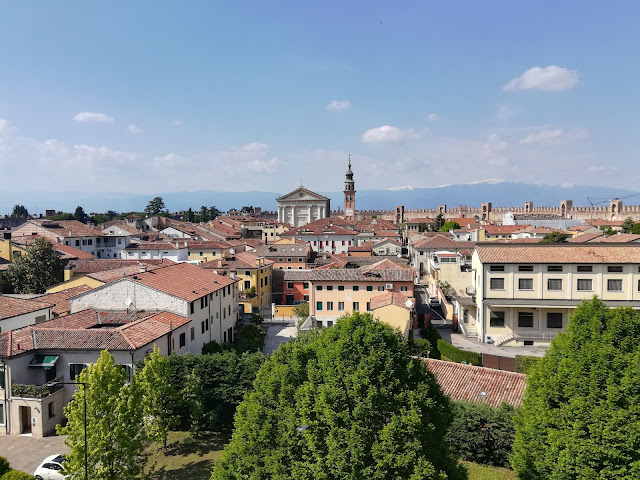
| View of Trebice |
 |
| One of the streets in the Jewish neighborhood |
 |
| The catle's baroque gate |
 |
| The portal of the Basilica of St Procopius |
 |
| Interior of St Procopius |
 |
| The facade of the St Procopius |
 |
| The Jewish cemetery |
 |
| The beautiful Renaissance houses in Telc |
 |
| The main square in Telc |
 |
| More houses |
 |
| Inner courtyard of the castle |
 |
| The castle chapel |
 |
| View of Telc from across the southern lake |
 |
| The main square in Jihlava |
 |
| The church of St James the Greater |
 |
| Walking along the walls |
 |
| The gate of the Holy Mother |
 |
| One of the streets in the old town |