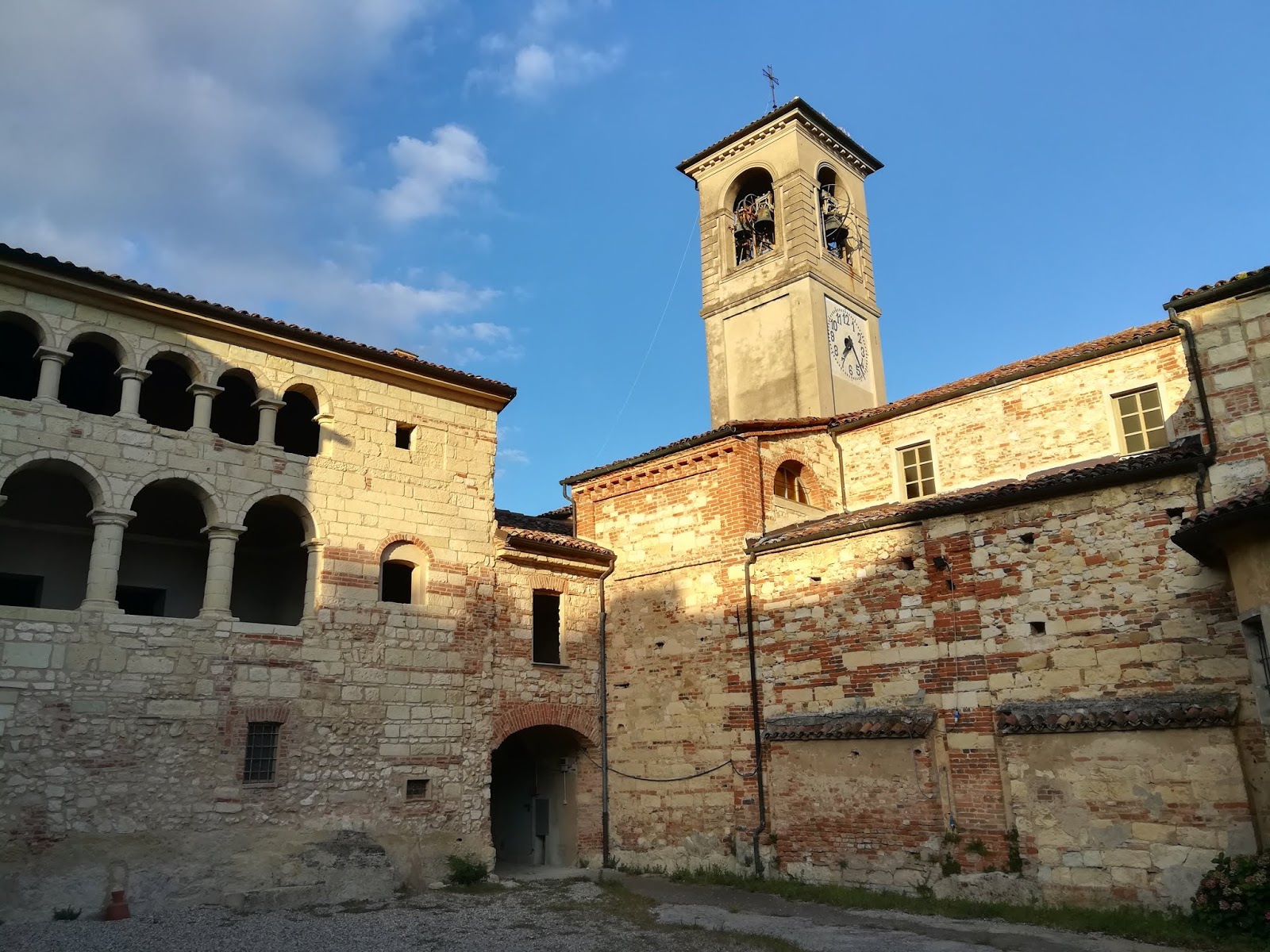
Showing posts with label vineyards. Show all posts

Monday, July 15, 2019

Gorizian Hills (30/09/2018)

On this day I convinced my parents to drive eastwards and visit the area around my grandmother's hometown, Gorizia. After taking the highway we reached the small town of Gradisca d'Isonzo and parked our car right outside the old town. Part of the club "the most beautiful villages in Italy" its city center features a set of 16th-century walls, built by the Venetians, which used to surround the whole town but whose western side was demolished to grant an opening due to the pace of times. As we walked along the northern walls, we passed by one of the fortified towers, built so to stand up to the improvements of the period which consisted of firearms thus requiring a change of defense all throughout Europe. We then entered through the city gate, Madonna della Porta, and climbed a part of walls where I had a nice view of the surroundings. We then went back down and walked along the perfectly straight outline of the streets. We entered the Duomo, dedicated to Saint Peter and Paul, featuring a mix of Neoclassical and Baroque exterior and interior with some older features such as the 16th-century tomb of Nicolò della Torre. Then through the streets, we reached again the location of our car, passing by the theatre, which was built during the 19th century when the town was governed by Austrians which loved to have some entertainment and had several cafés built next to it which still remain to this day. After taking the car we then drove further and reached the city of Gorizia, the birthplace of my grandma from my father's side. After parking the car and continuing on foot we figured out the city was quite packed with visitors due to a multi-day event called "Gusti di Frontiera" which consisted of stalls all along the city streets serving food from all over Italy and beyond. We reached the Piazza della Vittoria, the city's central square which featured a nice fountain representing Neptune and built-in 1756. On the western side of the square was the church of Sant Ignatius, unfortunately, closed at that time, but featuring a typical Baroque structure found throughout the former Austrian Empire, which the city belonged to for nearly 500 years. From there we walked along Via Rastrello, the main street cutting through the old town sided by beautiful buildings ranging from different periods. Then reaching Piazza Sant'Antonio a stage was set up for the event and food and drinks were being offered at its side. We took a glass and a snack and enjoyed the sunny weather for a bit. Then we started to get hungry so headed back through the town to a place called Trattoria da Gianni where we were seated after a bit of waiting due to it being fully packed. After ordering our dishes we found out by surprise that the dishes were huge and some plates were even too much for two people. My huge dish of gnocchi with four cheeses filled me up to the brink as I barely managed to finish it. After lunch we then walked further into the old town, passing by the Duomo which was unfortunately closed, and then walking uphill to reach the upper part of town. We passed under the Porta Leopoldina, a 17th-century gate dedicated to the Hapsburg Emperor Leopold I and entered what used to be the oldest core of the town, where some buildings, together with the church of Santo Spirito, built at the end of the 14th century, and the castle, were located. We headed for the castle, located on the highest point of the hill, and found out that entrance was free. That, unfortunately, meant it was full of people but we nonetheless managed to enjoy visiting it. Originally built during the 11th century it was later modified when the Venetians took control of the city at the beginning of the 16th century for a few months and upgraded it to sustain more modern warfare. The interior, though remade, featured some nice rooms with medieval furniture; while the terraces and windows provided amazing views over the old town. From up there, the border with the Slovenian town of Nova Gorica, which was just a few hundred meters away, could be clearly seen as well. After the visit to the castle, we walked back through the old town and got into the car to drive further. We passed through an area known as the Collio, or Gorizian Hills, crossing into Slovenia and stopping at a small town called Smartno. This small hilltop town used to be enclosed by a set of walls which had been later demolished and just a few traces remain. We walked through the pretty streets admiring the architecture and the beautiful view over the surrounding hills covered in vineyards which at that time were ripe with grapes. Driving then back into Italy we descended the hills and drove through the plains formed by the many rivers of the area, and stopping at a small town called Clauiano. Part of the club "the most beautiful villages" it is rather like a spread out village with no central square but spreading out from a central street cutting through the center. After a little walk around I didn't find particularly interesting and suggested to continue further. After a little drive further, we reached the town of Palmanova, a perfect example of star fort of the Late Renaissance built by the Venetians in 1593 to defend the land from invading armies coming for the east. It never served its purpose but served as a precursor to the many star forts which were subsequently built all around Europe. This is why recently it had been put into the Unesco list together with other Venetian works of Defence along the Adriatic and the Mediterranean Sea. We did not get a full overview of the structure by driving through, though a satellite image can fully show its size and design. From there it was time to go so we headed back on the highway and in the direction of Vicenza.


The walls of Gradisca d'Isonzo

Entrance to the old town

View from one of the towers of the walls and old town

The northern entrance to the old town

A street in the old town with church of S Addolorata in the background

The fountain of Neptune in the central Piazza della Vittoria in Gorizia

The porta Leopoldina, entrance to the city's castle

The church of Santo Spirito

The castle

View towards the south from the castle

One of the medeival rooms inside the castle

The castle's small courtyard

View of the old town from the ramparts

Vineyards between Italy and Slovenia

The small hilltop town of Smartno

One of the streets in Smartno


Monday, June 24, 2019

Genova & Moleto (10/08/2018)

After having completed our trip around Sicily, Ania and I flew to Turin where we met with a friend of hers and walked around the town a while. We then took a train and stayed for a few nights over at my relatives' house in Alessandria. The following day we decided to do a day trip and visit the port city of Genova, which I had visited plenty of times before but Ania had not. So after taking a regional train, we reached the Ligurian capital one hour later. As we walked along Via Balbi, constructed during the 16th century and one of the prettiest of the city, we admired the many rich and wonderful palaces lining the street. Many of them are part of the Unesco site, Palazzi dei Rolli, a group of palaces from the 16th and 17th centuries which were associated to a particular system of ‘public lodging’ in private residences, whereby notable guests on State visit to the Republic were hosted in one of these palaces on behalf of the State. Even though not part of this group, the Palazzo Reale, or Palazzo Stefano Balbi, was nonetheless worth a visit especially as it hosted a public museum. Originally built during the 17th century, the palace came into the hands of the House of Savoy and later of the Italian state who then turned it into a museum. The visit started with the historical rooms, mostly in the Baroque, Rococò or Neoclassical style. Each room contained a few paintings part of the art collection of the museum. Particularly noteworthy was the Hall of Mirrors, a rectangular room covered in mirrors and with splendid decorations, which reminded us a lot of the same in Versailles lest the crowds. Then the visit continued to the terrace where we had a general view of the surrounding buildings and of the port. Then back downstairs we also visited the small garden which had a beautiful floor made up of river stones in the shape of figures and animals. After the visit, right on the opposite side of the street, we then gave a quick look at the Palazzo dell' Università, one of the many buildings of the University of Genova, and once the Jesuit college. It featured a beautiful Baroque facade and courtyard which we were able to visit freely. Walking further on, we passed through another main street, the Via Garibaldi, lined with more beautiful Renaissance and Baroque palaces, some of which included in the Rolli list. At the end of the street, we then came out on Piazza De Ferrari, Genova's main and largest square. Surrounded by 19th-century buildings and a large fountain at its center, it links the old part of town to the modern one. It has been an important site for both the city and the country as it was the second most important financial center after Milan during the end of the 19th century. We were quite hungry so we decided to look for a place to eat something. We found a bakery/tavola calda and decided to grab some slices of focaccia and of farinata, made from chickpea flour, both typical of the city. From there we started our descent through the older part of town passing through the Piazza Giacomo Matteotti, where the Palazzo Ducale stands. Once the home of the Doges of Genova, it now hosts a museum which we decided to visit another time. Further downhill we reached Piazza San Lorenzo with the beautiful Cathedral of San Lorenzo, built between the 12th and 14th centuries in a mainly Romanesque and Gothic style typical of the area and featuring green and white marble stripes. After visiting the interior we walked down through the streets, quite narrow and here typically called Caruggi, until we reached the port. The largest in Italy it extends over several kilometers from west to east. The point we had reached consisted of the old port and the touristic part where all the leisure boats are parked. Right in front was also the Aquarium of Genova, the largest in the country and one of the largest in Europe, which I had seen countless times together with my family. We decided to enter the building facing the port which holds the famous food store Eataly, where we browsed the wonderful, yet overpriced, foods from all over Italy. At its top floor, we also enjoyed a wonderful view of the area and of the Bigo, a modern crane structure build by the famous architect Renzo Piano for the 1992 Expo. Then we walked back down and along the pier until we found a shadowed bench where we relaxed for a while taking in the fresh sea breeze. After that, we headed back through the old town and stopped to visit the Basilica della Santissima Annunziata del Vastato, a beautiful masterpiece of Mannerist and Baroque art. The interior presented a huge nave filled with lavish paintings and marbles and an impressively decorated cupola. From there the station was quite close, and we headed in that direction in order to take the next train back to Alessandria. After arriving, it was still afternoon, so I asked my aunt if I could borrow her car and drive Ania to a place I had previously visited. The drive was very pleasant and didn't take too long as the place was relatively close. We passed through the historical region of the Monferrato, included in the Unesco list and considered as one of the most important wine districts of Italy, comprising beautiful rolling hills filled with vineyards and with splendid views. We first stopped in a small town, Cella Monte, which had recently been added to the club "The most beautiful villages in Italy". Its pretty streets were filled with typical tuff houses and red brick rooftops and the views from there were incredible. Then, we drove to the nearby town of Moleto, the destination of our drive. Here, in fact, was a famous bar called Barchiuso which despite its name, is actually an open-air bar, with tables and seats spread over a large field on the top of a hill and overlooking the beautiful rolling hills and vineyards of the surrounding landscape. There we enjoyed the view and the sunset while sipping on a tasty local red wine. After the relaxing time, we finally headed back to Alessandria to have dinner with my relatives and then head to sleep.

The Hall of Mirror inside the Palazzo Reale

View of the inner courtyard of the Palazzo Reale

The beautiful mosaic floor of the garden

The mosaic floor and the palace in the background

The courtyard of the Palazzo dell'Università

The church of Santi Ambrogio e Andrea next to the Ducal Palace

The church of San Giorgio and the narrow carruggi of the city

The view of the potrt

The Basilica of the Santissima Annunziata del Vastato

View of the town of Rosignano Monferrato from Cella Monte

The medieval loggia and the town's main church

Sunday, June 16, 2019

Soave (10/07/2018)

Together with my brother, we decided to do a day trip to the town of Soave located more-or-less halfway between Vicenza and Verona. We thus took a train to the city of San Bonifacio and then started walking towards the destination. We stopped to admire the Abbazia di San Pietro di Villanova, a Romanesque abbey originally built in the 7th century. The doors were closed so we just had to admire it from the outside. The present form of the church dates to the 12th century and presents a large bell tower which we circled and took pictures of.  From there we then continued on passing under the highway and finally approaching the first houses of the town of Soave. We reached and entered the small church of San Giorgio dating probably to the 11th century. The interior, though quite small had some traces of medieval frescoes and an interesting large bone hanging from the ceiling probably coming from a whale. After exiting the church we walked along the impressive medieval walls of the city, one of its most famous landmarks. We then entered the old town through the southern gate, Porta Verona, built during the 14th century. We walked along the main street and reached the Palazzo di Giustizia, built during the 14th century and serving as the building where the city governor used to stay. From there a narrow street leading uphill took us to the castle entrance, where we bought the ticket and entered. Probably built during an early period, its current form is thanks to the refurbishments made by the lord of Verona, Cansignorio della Scala, who, during the 14th century also built the walls we see around the city today. After several centuries of military use, it was then not suitable for modern warfare and was thus sold and turned into a farm. During the 19th century, the then mayor of Verona bought the partly ruined castle, refurbished it and turned it into a private residence. The structure of the castle is made up of the main keep with a small courtyard surrounded by walls, then another larger courtyard with another set of walls. We first passed through the exterior courtyard and then through a small door entered the smaller interior courtyard. At its center is an old well which served as cistern and next to it the refurbished captain´s house with a beautiful staircase leading to it. We climbed it and visited the rooms which contained copies of medieval furniture. We went up another staircase and reached the walls from where we had a great view of the city below. Then up to the top of the keep´s tower where we could see the whole complex of the castle and the town with its walls right below. After enjoying the scorching sun and view from there, we descended back down in the town and entered the church of San Lorenzo, which was open. Originally dating to the city´s foundation it was then rebuilt due to its small size, in a Baroque/Neoclassical style between the 18th and 19th centuries. As we were getting hungry, we found a Panetteria close to the church where we had a slice of focaccia and pizza and ate it while sitting on a bench right outside Porta Verona. After lunch, we got back on our feet, crossed the old town again and exited the northern gate, Porta Aquila. We continued walking, past the church of San Rocco, built during the 15th century and then up a hill. From there we had a great view of the castle in the distance, and all around us beautiful green vineyards. We walked further, passing hills full of more vineyards and taking beautiful countryside paths. After a bit of walking, we finally reached the first houses of Monteforte d´Alpone. We could easily spot the high bell tower of the main church, which we always see while driving on the highway from Vicenza to Verona. Once we reached the church, we admired its facade, built during the 19th century in the Neoclassical style. Next to it stands the Bishop´s Palace dating to the 15th century, with a small loggia featuring traces of medieval frescoes. From there we finally headed on walking and after a few kilometers reached the train station of San Bonifacio once more where we took a train back to Vicenza.

The Abbazia di San Pietro di Villanova

Street in Soave

The castle walls

One of the rooms inside the captain's house

View of the keep and the courtyard

View of Soave from the top of the keep

A countryside road close to Soave

The church in Monteforte d'Alpone