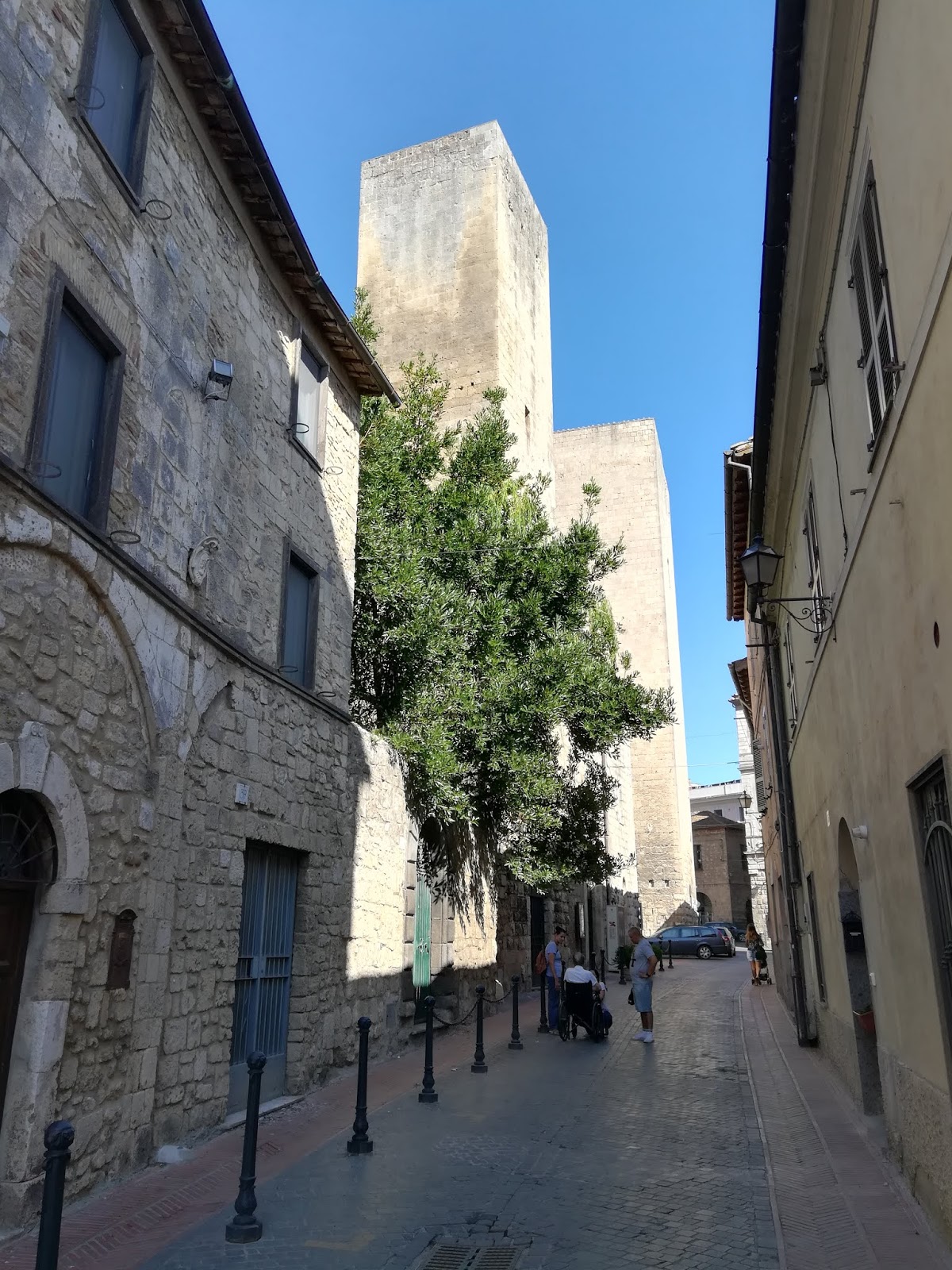
At the end of July, I decided to head to Rome to visit my brother who was working there. After a few days in the city, I decided to head outside and visit the city of Tarquinia, which together with Cerveteri, which I had visited back in April, are inscribed in the Unesco World Heritage Site List for their Etruscan tombs. So, after taking a local regional train from the Rome Trastevere station I reached the station of Tarquinia in just over an hour. After reaching the station, I had to walk for about 45 minutes before reaching the town proper, as it is typical of areas in this part of Italy stations were built on lower ground and quite far from city centers. Once I reached the city I then headed east and reached the entrance of the Archaeological site where the famous necropolis of Monterozzi is set. This Etruscan necropolis, unlike the one I had visited in Cerveteri which is known for its typical tomb mounds, is known for the beautiful and well-kept painted tombs which are mostly unexpected as they are all underground. After entering the archaeological area, I decided to follow the path and visit the tombs one by one in succession. The way was clearly marked and it was impossible not to miss each of the entrances to the tombs, unlike in Cerveteri where they were more scattered, surrounded by forest, and easier to miss some. The Necropolis of Monterozzi is the best preserved and only publicly visible of the necropoleis that used to surrounded the ancient city of Tarchuna. It holds about 6000 graves, 200 of which are decorated with frescoes, and the oldest of them dating to the 7th century B.C. Unfortunately, not much is known of the Etruscans however thanks to their necropoleis, their quotidian life, ceremonies, and mythology are partly revealed. These particular painted tombs are the best example in the Etruscan world and have no other example elsewhere. At each point where the tombs were located, a small building topped the entrance from where I always had to take a staircase leading down below ground to where the actual funerary chamber was located. Among the many that I visited, the most impressive ones were the Tomb of Hunting and Fishing, the Tomb of the Blue Demons, and the Tomb of the Leopards. The first dates to the end of the 6th century B.C. and as its name suggests depicts scenes of hunting and fishing. Particularly interesting is the fresco of the back chamber which depicts fishermen on a boat and some bird flying away disturbed by their presence. It is thought that due to it being one of the older tombs and because of its reduction of humans to small figures in a large natural environment, there were no precedents for this in Ancient Greek art or in the Etruscan art it influenced and it was a major development in the history of ancient painting. In fact, the famous Tomb of the Diver that was found in Paestum dates to about 30 years later. The Tomb of the Demons dates to the end of the 5th century and is named so because of its depiction of blue and black-skinned demons that appear in an underworld scene on the right wall. The demons are usually represented with Charun, the Etruscan name for Charon, Hade's ferryman, and serve as his assistants. In this case, the frescoes represent the theme of a dangerous journey to the underworld with threatening demons. This contrasts with the cheerful dancing and symposium scenes in painted tombs of the Etruscan Archaic and Early Classical periods found around the archaeological site. The Tomb of the Leopards is probably the best known of Tarquinia as its mural is one of the best-preserved and is known for its lively coloring, and its animated depictions rich with gestures. It dates around 480-450 BC and it is named so because of the two confronted leopards painted above a banquet scene. In this case, the banquet scene itself is probably the most exciting part of the painting as it is so well preserved and clearly shows with vivid colors the deceased's funerary banquet with elegantly dressed male-female couples attended by two nude boys carrying serving implements. As I finished touring the tombs all the way to the eastern end of the site I then walked back towards the entrance through the path that followed the rim of the hilly plateau on which it was set. From there I had a commanding view of the surrounding landscape mostly dedicated to farming. Once outside the archaeological site I then walked a little while before I finally reached the medieval walls of the old town of Tarquinia. Once inside the city center, I first passed by the church of St Francis built in a gothic style which was closed. Not far ahead I got to the northern part of the town where the Porta Nuova city gate was located. There, a nice belvedere granted a great view of the hills to the north. Then I crossed the city's main square Piazza Giacomo Matteotti, where the Palazzo Comunale is located. Dating to the 13th century it received some alterations throughout the following centuries but still maintaining its original structure; it now serves at the town hall. A little further ahead along the Main Street, Corso Vittorio Emanuele, I then reached Palazzo Vitelleschi, a beautiful 15th-century palace in a mix of Gothic and Renaissance styles. It now holds the National Archaeological Museum of Tarquinia which I decided to visit. The museum holds the artifacts which were excavated from the nearby Necropolis of Monterozzi which I had just visited so it was a great way to fully understand the archaeological site and the funerary traditions of the Etruscans. My visit started by crossing through the beautiful inner courtyard and along the ground first which presented the sarcophagi in chronological order starting from the middle of the 4th century BC, some of which even painted. Upstairs, the first-floor showcases pottery from the Villanovian Culture (900-700 BC) all the way to 4th-century examples, some even imported from Ancient Egypt, Greece, and Phoenicia. Finally, the third floor showcased other objects and the restored paintings of some of the tombs from the archaeological site. From that top floor, I also enjoyed a nice view over the old town with its numerous medieval towers which characterize the skyline of the center. After the visit to the museum, I then decided to walk further and reached the Duomo, originally built in 1260 but later fully refurbished in the 19th century in its current Neoclassical style. After passing through a city gate of the medieval walls I then reached the western end of the old town where the Church of Santa Maria di Castello is located in a rural setting. The church, a beautiful example of Romanesque architecture built between the 12th and 13th centuries was unfortunately closed so I was not able to see its interior which was said to be full of mosaics. Another belvedere close to the church made me forget the fact the church was closed and granted a beautiful view of the landscape. After crossing back through the city I passed by the Romanesque church of San Pancrazio which was closed but managed to enter the church of San Marino. Built around the 11th century it features a nice plain interior with some traces of 15th-century frescoes. It was then time for me to go, so after exiting the medieval walls I headed in a southerly direction eventually reaching the station from where I took a train back to Rome.