Monday, July 22, 2019

Husum, Friedrichstadt & Glückstadt (17/11/2018)

On this day we decided to head north into Schleswig-Holstein and reach by train the town of Husum located in the proximity of the North Frisian Wadden Sea. After reaching the destination we continued on foot and walked through the town center, passing by the church of St Mary dating to the 19th century, and through the Markt, the main square. The weather was fine, sunny and not too cold and we enjoyed strolling around for a bit. We then walked under an arched house and through a pretty street until we reached the castle. Being the only defensive structure on the western coast of the state, it shows how the city had an important role in the area. The castle was built in the Dutch Renaissance style during the 16th century under the request of Duke Arnold von Schleswig-Holstein-Gottorf. It is surrounded by a moat and a nice small park. We saw that visits were only through guided tours and later in the afternoon so we decided to just admire it from the exterior. As we walked further we passed by the Ostenfelder Bauernhaus, a perfectly preserved example of a 17th-century farmhouse which was dismantled and carried from the eastern part of the state and reassembled in this location.
Unfortunately, it was closed so we decided to take a picture and continue onwards. We walked along the nice small harbor and then headed back to the station where we took a train that took us in just a few minutes to the town of Friedrichstadt. After getting off the train we then headed towards the city center which was just a few minutes on foot. The town is known for its well kept old town characterized by two islands divided by a canal and surrounded by water. It reminded us a lot of a typical Dutch city and it was in fact founded by Dutch settlers in the 17th century encouraged by Duke Friedrich III of Holstein-Gottorp who promised them religious freedom. As we walked through we reached the Marktplatz, the town's main square which featured some nice gabled houses on its western end. We then crossed the canal that splits the town in two and visited the northern island where alleyways were laid out in a perfectly symmetrical and orderly as the rest of the town. The island ended where the Treene river had formed a large body of water still used to this day to direct its waterway in the town's canals. As we walk back towards the southern island, we then passed by the Remonstratenkirche, the church dedicated to the early inhabitants who practiced the protestant remonstrant religion. It was interesting to see the dedications on the church's facade all written in dutch. From there, walking along the pretty streets we reached the train station and took another ride further south reaching the small town of Glückstadt. Literally translated as "luck city" it was founded in the 17th century by King Christian IV of Denmark promising the settlers to be exempted from taxes and free to profess their religion. Its location on the Elbe was meant to serve as commercial competition to the much larger and important city of Hamburg, a position which it never achieved. After getting off the train, we decided to walk through the center, passing by the Stadtkirche which was already closed. From there we continued through the Marktplatz and then a little further until we reached the small harbor. Here we walked along the waterside until we reached a concrete pier jutting out into the Elbe river. The sun was setting so we stayed there for a bit while enjoying the beautiful over the river and the surrounding landscape. After that, we headed back into town,  grabbed a few fries from a shop and then headed to the train station where we took the day's final ride back into Hamburg.


The main square in Husum

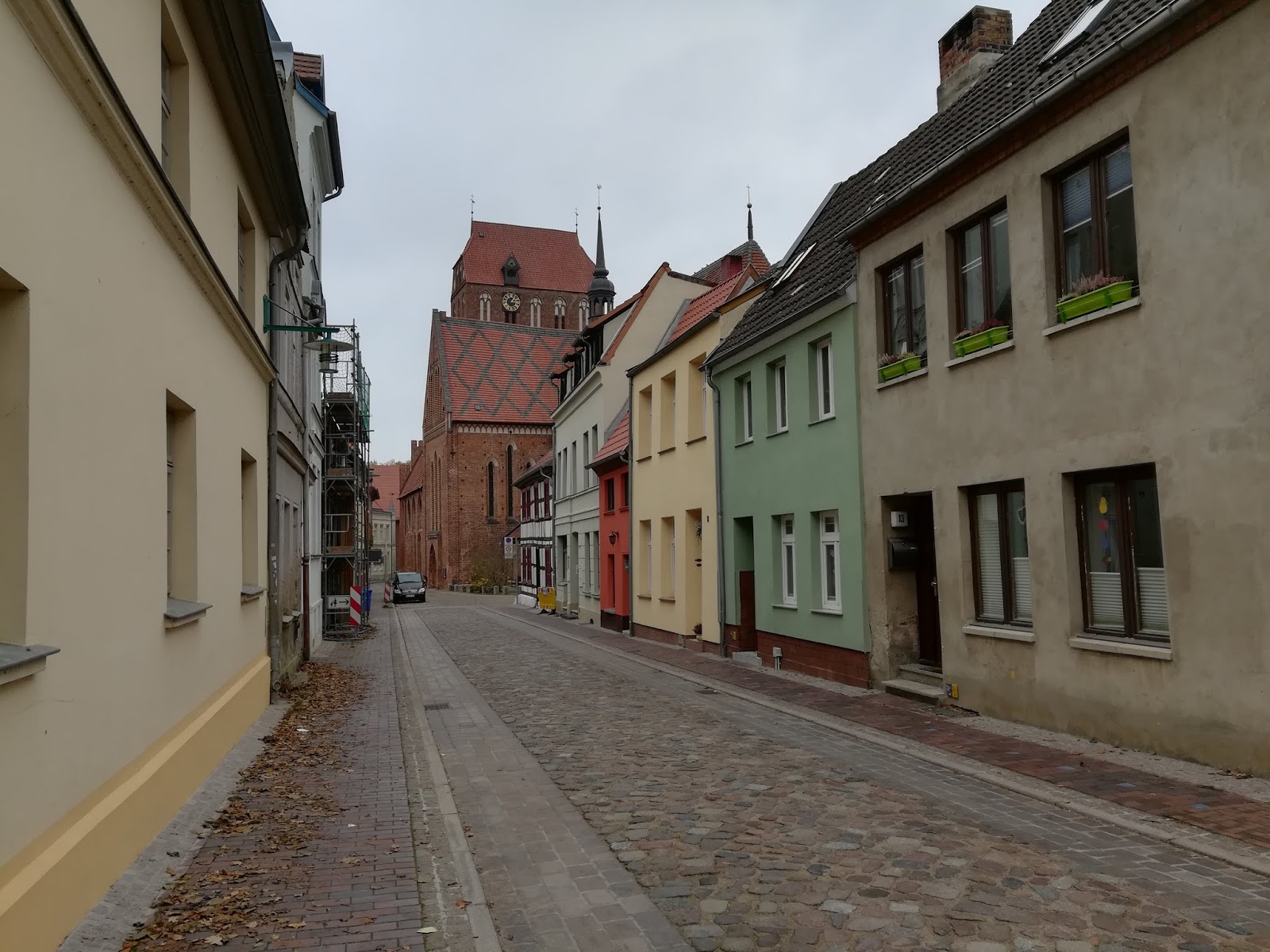
A street in the old town

The Husum Castle

The Ostenfelder Bauernhaus

The harbor of Husum

A canal in Friedrichstadt

The main square

Detail of the gabled houses

The central canal

The church of St Cristopher

A street in the old town

A nice house in the old town

The Stadtkirche in Glückstadt

The harbor

A street in the old town

Another view of the town

The pier on the Elbe river with the surrounding mud flats

Sunday, July 21, 2019

Güstrow (04/11/2018)

After planning to head once more north into Schleswig Holstein, I figured out we had bought the wrong ticket and so had to switch trains and direction and head east into Mecklenburg Vorpommern. After reaching the town of Güstrow, we headed towards the city center and had a quick look at the Chapel of St Gertrude. Built right outside what were once the city walls, this Gothic 14th-century chapel sits in a nice setting surrounded by a little park. A sculpture exhibition was organized in its premises so we decided to skip the visit as it involved buying a ticket. We then headed towards the center and stopped by the Cathedral to check it out. Unfortunately, it was closed so we decided to head further and reached the Marktplatz right after. At its center stands the church of St Mary which we decided to visit. Built around the 14th century, the original building burned to the ground and was substituted by another structure a century later. It was then highly refurbished and restored around the 19th century giving it its present brick gothic style. Walking around the interior we admired the nice wooden winged altar of 1522 and then headed climbed the 53m bell tower. Once up there we had a nice 360° view of the old town despite the cloudy weather. Once back down, we then walked through the main square and admired the nice gabled tenement houses covering its perimeter. Then through the streets, we reached the Cathedral once more and luckily found it had reopened. Even though called "Dom" it is actually not a cathedral as the bishop's seat is located elsewhere. Built in 1335 it features a typical brick gothic structure which a large central nave and some Romanesque features from its beginnings. We admired the nice interior particularly focusing on the late gothic winged gilded altar, a beautiful 16th-century renaissance monument do Duke Ulrich and a flying apostle figure statue modeled in 1927 hanging above the 18th-century cast-iron baptismal font. After visiting the church we then headed a little further and reached the city's main attraction: the Güstrow Palace. This castle-palace was built in 1558 for Ulrich, duke of Mecklenburg, the same one buried inside the Dom. Refurbished the following century it features a beautiful mix of Renaissance and Baroque styles. We bought the entry ticket and then proceeded to tour the interior. The lower rooms featured art from the early gothic to the renaissance period with several gothic altars to exhibit. The upper rooms featured paintings from the 16th century onwards including some from Montagna, Palma il Giovane and Tintoretto. Among the many rooms, one which caught our attention was the one which was used as a banquet hall and decorated with interesting stuccos consisting of hunting scenes where the animals actually featured real deer horns embedded into the ceiling. Once the visit was complete we decided to head back to the station from where we took the next ride back to Hamburg.


The Cathedral

View of a street in the old town

The Palace

Another street in the old town

The church of St Mary

View of the old town from St Mary's belltower

View of the town hall

The main square with colorful houses
Interior of the Cathedral


Duke Ulrich's tomb

The flying apostle statue

The Palace


The palace's courtyard

The banquet hall decorated with hunting scenes and real antlers


Thursday, July 18, 2019

Hedeby & Schleswig (28/10/2018)

From Hamburg we did another day trip, this time heading north to the state of Schleswig-Holstein. Our destination was the small town which gave its name to the first part of the state. After reaching the train station we headed on foot in the direction of the archaeological site of Hedeby, a little further to the southeast. We walked along a bike path running beside the Schlei Forde, a small inner bay connected to the sea with a view of the town of Schleswig across the sound. We then reached the site where the Haithabu Museum is located right next to the location of the archaeological area. The names Hedeby, in Danish, and Haithabu, in German, are both used for the site. The archaeological area used to be the location of an important Danish Viking age trading settlement which flourished between the 8th and 11th centuries. Its location was very important, as the inlet in which it is set is quite far inland from the Baltic Sea and a small 15km stretch of land separates the settlement from the Treene River which then, in turn, flows towards the other side of the peninsula into the North Sea. So through a short corduroy road made of logs, goods and even ships could be moved from one sea to the other without having to circumnavigate the whole Jutland peninsula. This is why then an earthen wall topped by a palisade called the Danevirke was constructed connecting the walls of Hedeby all the way to the Treene River to form a protection for the trade. After a prosperous period, the town fell into decadence and was finally ransacked and destroyed first by the King of Norway Harald Hadrada and later by West Slavs. It was then abandoned and the population spread throughout the land eventually crossing the bay to the other side where they founded the town of Schleswig. So after buying the ticket, we entered the nice museum which exhibited all the objects that were excavated from the site. Golden brooches, stone runes, and longships were displayed alongside objects of everyday use. It was a nice way to gather info regarding how people in that age lived in such a northern mercantile settlement. After visiting the museum we then walked further and reached the actual archaeological site which was located in a semicircle at the end of the bay and surrounded by an earthen ring which probably coincided with the town's walls. A group of sheep was grazing as we entered the area and continuing on also met a group of grazing Highland cows which looked so fluffy. We then reached the site where a series of Viking houses and huts had been reconstructed right by the waterside. The interiors were made to show how the houses were made and to illustrate their use. After taking a few pictures we then decided to head back and walk all around the bay to visit the town of Schleswig. The weather was kind to us as a windy yet sunny day was giving us a pleasant visiting experience. After quite some walking along the bay, we finally reached the town and walked past the small harbor and through the old town. Then we walked through the eastern end where the fishing village of Holm was located. Once a settlement on its own nowadays it forms part of the city and a continuation of the old town. The houses there were very pretty and well kept and we decided to have a hot lunch at the only cafè, the Holm Cafè. We both took soups and enjoyed them very much. After filling up we then walked around admiring the view of the bay from the piers of the fishing houses and passed by the monastery of St John at the end of the village. Then, walking back from where we came, we stopped to have a look at the large Cathedral. Built during the 12th century in the Romanesque style it was slightly modified in the following centuries thus largely maintaining its original appearance. The Petri Portal, dating to 1180, which we used to enter the church was evidence of that period. Once inside we marveled at the beauty of the nave which I had not expected so far north and in such a small town. A beautiful choir, which was unusually divided by a crucifix, common in the pre-reformation churches, held a nice 16th-century oak wood altar. Next to it a renaissance tomb from 1552 was meant as a cenotaph for Frederick I, King of Denmark and Norway and Duke of Schleswig and Holstein. Also, the cloister, set in the northern side, presented a nice mix of Romanesque and Gothic, having been built during the 14th century. It was interesting to walk through it as the hallway and arches were all crooked due to the sandy ground and long centuries it has been standing on. Once outside we then walked again through the town and reached the Gottorf Castle. Built and rebuilt several times through its history, its present form dates to the Baroque refurbishment of the early 18th century. We did not visit the interior as it was just before closing time and instead walked through its large park and reached the northern part where a nice terraced garden had been built up the hill and featuring a pond and observation house. It was then time to head back, so after walking through the old town we finally reached the train station from where we took our ride back to Hamburg.


View of the town of Schleswig

A viking brooch

Herd of sheep in Hedeby

View from the Hedeby ramparts

Highland cows in Hedeby

The viking village of Hedeby


View of the huts

The interior of the Schleswig Cathedral

The wooden altar

The cenotaph to Frederick I 

The cloister

View of the main portal

A street in the fishing village of Holm

Another street in Holm

Street ending in the water

The small harbor with the fishing houses

Gottorf Castle

Old buildings in the city center

Wednesday, July 17, 2019

Greifswald & Stralsund (14/10/2018)

Another weekend meant another day trip from Hamburg. Traveling again through Mecklenburg-Vorpommern, we decided to head further east and reach the town of Greifswald, once part of the Hanseatic League and now a popular university city. After reaching the train station we headed on foot through the old town and reached the Fischmarkt, a small square sided by nice buildings. At its eastern end is the town hall, originally built in the 13th century, its present form dates to a Baroque reconstruction and is characterized by a bright red color. The building marks a sort of division between the Fischmarkt and the larger Marktplatz, the city's main square. All around it some nice mix of gabled burgher houses mostly from the Baroque and Neoclassical periods with also a Gothic one at the eastern end. Not far on we then visited the church of St Mary, located at the eastern end of the old town.  Built around the 13th century it was then refurbished the following century in its present brick Gothic form. We entered the building and admired the large and airy, albeit lacking in decorations, interior. As we then headed back through the main square we reached the town's main church, St Nikolai. Dating to the 13th century it presents the typical brick Gothic style with the bell tower having been rebuilt during the 17th century after the original one collapsed. The whitewashed interior presents very little of the original furnishings but is nonetheless worth a visit. Continuing further, we then passed by the university's main building, a nice palace dating to 1750. The university itself though is much older, having been founded in 1456 and thus making it the fourth oldest in Germany. Not far ahead we passed by the church of St Jacob, which was unfortunately closed for renovation, and reached the train station once more from where we took our transportation to the next city: Stralsund. Another Hanseatic town, this city, together with Wismar which I had seen in 2017, is part of the Unesco list due to their old towns rich in heritage. We immediately noticed that as we exited the train station, and crossing a bridge reached the nice historical center surrounded by water. Our first stop was the church of St Mary, built during the 13th century in brick Gothic. Its tower, which was rebuilt several times during history, the last of which in 1708 in the Baroque form, was the tallest in the world between 1549 and 1647 at 151m. The interior presented a nice mix of Gothic structure with Baroque decorations including a large organ. We continued through the streets and reached another church, St Jacob's. Built during the 14th century it features a large thick tower and a long central nave. As we entered we found out that despite being used as an art exhibition space it still featured some decorations such as the pulpit and main altar. Moving forward we passed by some nice streets with gabled burgher houses and then reached the city's main monument: the church of St Nicholas. The oldest church in the city, it was built during the 13th century and features a large brick gothic structure with two bell towers originally built during the 14th century. One of the towers received a new spire in the Baroque form during the 17th century after the previous one collapsed together with the other one which was never rebuilt. The main portal, featuring a beautiful renaissance door with decorations, was closed but the entrance to the church took place from the southern side portal. Once inside we marveled at the impressive structure which featured Baroque altars and fitting which replaced the mostly empty interior after the original gothic furnishings were removed during the 1515 iconoclastic fury of the Reformation called Bildersturm. Particularly noteworthy were the altars with nice decorations including the main altar with a well-made crucifix. On the southern side of the altar are some remaining wooden reliefs which used to cover the whole perimeter. The four reliefs dating to 1420 represent some Russian/baltic traders with long beards and wearing hunts in the act of chopping wood, hunting wild animals, and then trading with Stralsund merchants. Once outside the church, we sat down on a bench in the middle of the Alter Markt, the town's main square. Here we had the lunch which we had brought with us and admired the beautiful buildings surrounding the square focusing on the southern side which was covered by the impressive structure of the church and of the north german brick gothic city hall with a beautifully decorated facade built around the 13th century. As we continued on we walked past the Kniepetor, one of the few remaining city gates, and then entered a small courtyard featuring beautiful timber-framed houses. Right next to it were the ruins of St John's monastery, built during the 13th century and left into ruins after it was destroyed once in the 17th century and again during WWII. Walking further we then reached the eastern end of the old town where the modern Ozeaneum building is located. A public aquarium, it is part of the German Oceanographic Museum, the most visited museum in northern Germany. We decided to skip it and head further until we reached the Hospital of the Holy Ghost, a religious complex built during the 17th century which served as recovery and accommodation for the poor and ill. The complex featured a long row of buildings with timber frames and with a bright red color. Finally, we decided to head back through the old town and reach the train station from where we took a train back to Hamburg.


The Fischmarkt with the town hall in Griefswald

Another view of the Fischmarkt

The Marktplatz with the church of St Mary

A gothic house on the main square

Vuew of the Fischmarkt and the church of St Nikolai

The belltower of St Nikolai

The church of St Jacob and St Nikolai in the background

A street in the old town of Stralsund with the church of St Mary in the background
The city's main church, St Nicholas

The beautiful western door

Interior of the church

The wooden relief of the Russian/Baltic traders

The altar and cross inside the church

View of the church of St Nicholas and the town hall on the main square

A street in the old town

A nice courtyard with timber-framed houes

The church of the Holy Ghost

Part of the complex of the Holy Ghost

View of the church of St Mary