Tuesday, March 22, 2016

Cremona (03/02/2016)

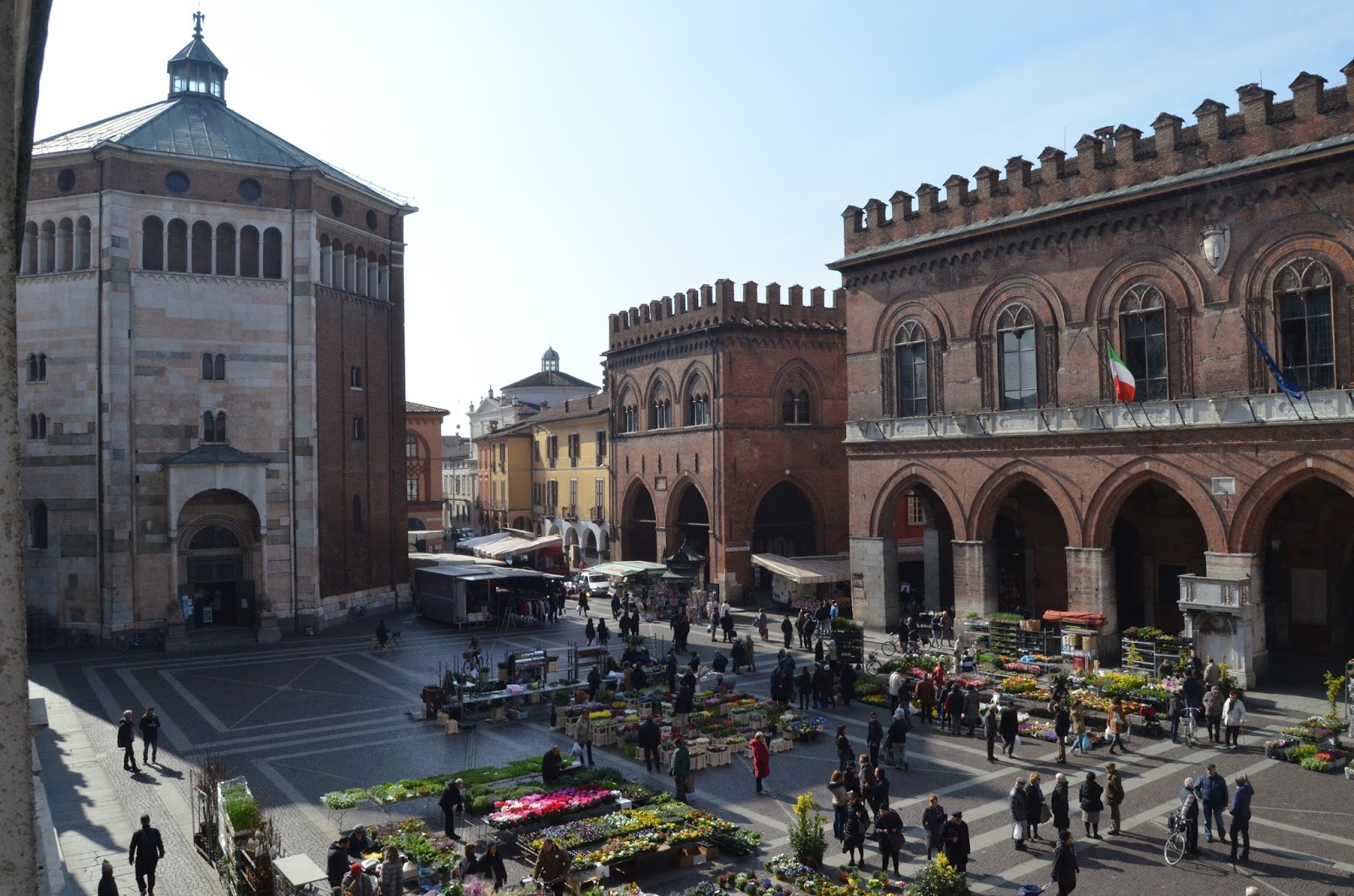
On this day I decided to travel with my aunt who usually works out of town and travels a lot so I decided to get a lift to the city of Cremona. After being dropped off in the city center I immediately headed towards the main square. The bell tower, the second highest in Italy, was immediately visible from the highway so I just had to look up to figure out the way. Once I reached the impressive Piazza del Comune, I was awed by the beauty of the Cathedral and the bell tower right next to it. The Duomo, built in the Romanesque style, had several later additions in the Gothic, Renaissance and Baroque style. The facade built in the 13th century is an absolute masterpiece and surely one of the best looking in Italy. I then went inside, and marveled at the Baroque decorations which covered most of the interior yet did not seem out of tone with the older structure of the building. There were still several medieval decorations such as a few frescoes and tombs. The main painting of the church hangs on the counter facade and is the Crucifixion by Pordenone. I then decided to head out to visit the rest of the square. Right in front of the Cathedral are two medieval buildings, the Palazzo del Comune, or City Hall, and the Loggia dei Militi, or Soldier's Loggia which served as another government building. From there I turned right and bought the combined ticket for the bell tower and the Baptistery, and headed up the tower first. The so called Torrazzo, is the third tallest brick tower in the world, and the oldest among those 3 towers. Completed in 1309 its height reached 112m and after having walked up more than 500 steps I reached the top where I had a wonderful view over the town below and the surrounding countryside and the Po river towards the south. It was also really nice that I was the only tourist and visitor up there enjoying the views. I then descended the stairs and went in the Baptistery. A friendly old man at the ticket booth asked me where I was from and started talking about the building's history and of the city too. Built around the time of the Cathedral it's another wonderful example of Romanesque architecture, and as most other Baptisteries it was built in an octagonal plan. The interior though not frescoed as other Baptisteries, still had a nice look to it. It was time for lunch so I asked for some suggestions at the tourist info point and went with the nearby Ristorante Centrale. Though a bit old looking on the inside (like an 80s decor) I had a really good typical Cremonese dish: tortellini in broth.  After lunch I headed north and after walking a few block I reached the city's main museum; The Ala Ponzone Museum. Inside were several 16th and 17th century paintings such as a beautiful and strange painting called the Ortolano by Arcimboldo, a famous 16th century painter known for representing people with fruit and vegetables. There were also some rooms with 18th and 19th century pantings, a part with asian porcelains and an archaeological section with greek and roman objects, and finally a last room with the famous violins of which Cremona is known worldwide. After exiting the museum I walked along a few streets passing by some really nice palaces, such as Palazzo Fodri and the Palazzo Stanga Trecco with a really nice courtyard with a renaissance loggia. I then walked on and reached Via Garibaldi, where the house of famous luthier Stradivari stands. Not far up the street is another medieval building very similar to the city hall called Palazzo Cittanova, and right in front the Church of St Agatha rebuilt in a Baroque and Neoclassical style with a famous painting by Boccaccio Boccaccino. Close by was another splendid palace, and probably the best looking in the whole city; the Palazzo Trecchi. First built in the 15th century it was then refurbished and modified in the 19th century and had some beautiful red columns and loggias all around the courtyard. There was even a small plaque showing the place where Garibaldi had a picture taken of him on horseback. On the same street not far, I visited the small yet very nice church of Santa Rita, with some great renaissance paintings and colorful marbles. Walking on I then entered the Baroque church of Sant'Ilario and passing by the beautiful Renaissance Palazzo Raimondi, which seemed it would fit much better in Ferrara than a city of Lombardy, and reached the church of San Luca, which still had some medieval traces remaining particularly the facade, and some of the columns inside, one of which had a strange jewish incrisption. From there I headed back in towards the city center and stopped at the church of Sant Egidio e Omobono, which looked closed and under restoration but the guardian, seeing me peek inside, asked me if I wanted to enter and I responded affirmatively. He then asked me where I was from and happily remarked he had visited Vicenza in the past and had really liked it. After my visit he then suggested I go visit the church of Sant Agostino which had a famous painting by Perugino. In fact not far ahead I reached said church, which had a beautiful interior with a mix of Renaissance and Baroque decorations, particularly rare and interesting were the statues decorating the central nave. I then admired a beautiful marble chapel and right next to it the Cavalcabó Chapel with interesting frescoes and finally the magnificent painting by Perugino. It was then time to head back home, and while waiting for my aunt to come pick me up I decided to give one last look at the main square with the magnificent Cathedral.

Interior of the Cathedral

View of the Cathedral and the bell tower, Torrazzo

View of the main square with the Palazzo del Comune, Loggia dei Militi and Baptistery

View from the top of the Torrazzo

View of the city from the Torrazzo

Another view from the top

View of the Cathedral and Baptistery

The Ortolano by Arcimboldo, if turned upside down it looks like the portrait of a man

Painting of Cremona

Palazzo Trecchi

The painting by Perugino

Modern and old architecture

Sunday, March 13, 2016

Netherlands (22-24/01/2016)

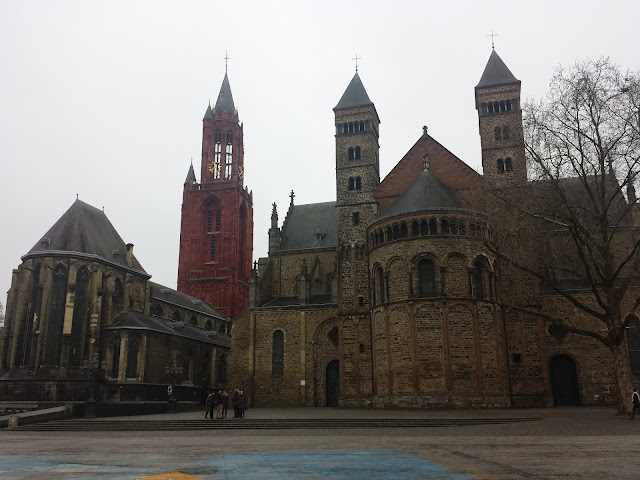
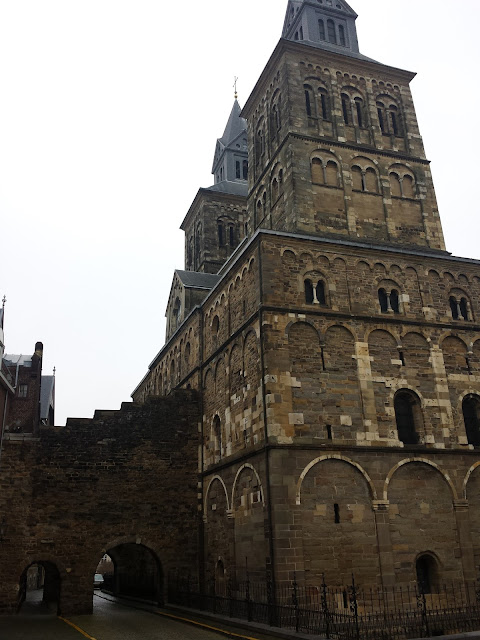
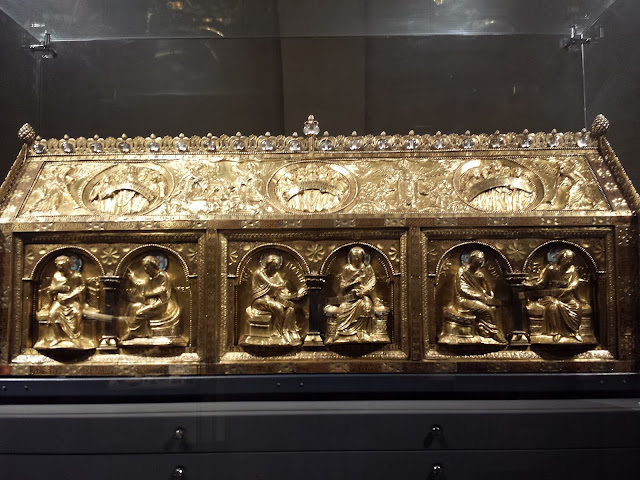
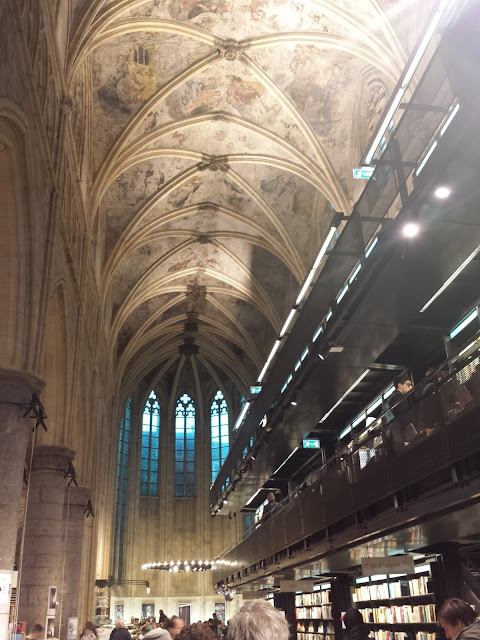
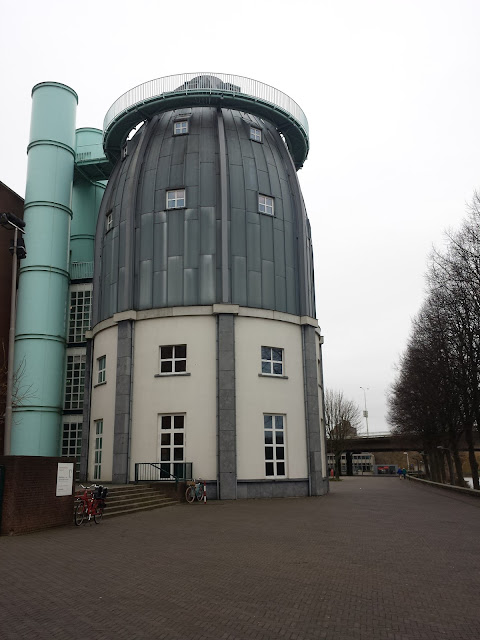
For my brother's birthday I decided to visit him in the Netherlands since he was staying in Rotterdam for a while. I left early on the 22nd from Venice airport and on the flight towards Amsterdam I met my high school friend Renato. We talked for a while at the airport about the past and the present after saying goodbye I took a bus and with 5€ headed for the city center. I stopped right in front of the Museumsplein as I still had to visit the Rijskmuseum from the last time I had visited Amsterdam. After paying a quite hefty price, 17,50€, I started the visit of this huge museum. As I had planned, it took me several hours to see all the objects and paintings showed throughout the 3 floors. I started with the early middle ages, notably Flemish and Italian paintings, then on to the Asian collection which was different and very interesting, then up to the Dutch Golden age with famous painters such as Rembrant, Vermeer etc. with masterpieces such as The Milkmaid and The Night's Watch, and then finishing with the Rococo and Napoleonic period. After the visit it was time to head to Rotterdam so before catching the train I decided to walk across the city center and enjoy the sights once more before leaving. I crossed the many canals and streets dotting the city, passing through the main square, the Dam, and then red light district with its old architecture, notably the Old Kerk, and eventually reaching the station where I took the next Intercity headed for Rotterdam. After buying groceries at the supermarket we had a quick dinner and then went to bed quite early ready to leave for Maastricht on the next day. So after waking up quite early we took the train and after 2 hours reached the city of Maastricht. We decided to spend the night there so we booked the Bastion Hotel on the northern part of town. Exiting the train station we headed for the city center and crossing the medieval Sint Servaasbrug bridge we had a great view of the city. After walking along the pretty streets we reached one of the main squares, the Vrijthof, where the Basilica of Saint Servatius and the Sint Janskerk stand imposing with the facades facing the opposite way. We decided to visit the Basilica, a beautiful example of Romanesque architecture with an imposing Westwork, or fortified towers (typical of this area). Ticket was only 2€ and hosted and really nice Treasury with some amazing golden relics. Though modified, the interior still keeps some medieval traces such as tombs and frescoes here and there, particularly nice was the chapel with a mosaic depicting Jerusalem at its center and a nice painted Renaissance portal. It was then time to eat so we looked up a good place to have lunch. We walked a little on and reached a small café/bakery called Bisschopsmolen, so called because it used to be a watermill. I had a really good sandwich made with local Limburg ham and drank the local apple juice! The juice was so good we decided to buy it there 2 times in the 2 days we were staying in the city, From there we went on to visit the imposing Basilica of Our Lady, also Romanesque styled and with a really nice fortified westwork. Though badly lit, the inside was still quite nice, particularly the devotional 15th century statue of Mary, here called Star of the Sea, however the treasury was unfortunately closed during our whole stay so we weren't able to see it. After exiting we walked sothwards and reached the remains of the medieval wall and the Helpoort, or Hell's Gate. From there we walked along the ramparts and after crossing the city center again we reached the other main square, the Markt or market square, with the town hall at its center. We then headed for our hotel where we checked in and left our bags before heading out again. We then entered a deconsacrated church, the Dominicanenkerk, which had been beautifully transformed into a bookstore. My brother's Belgian friend, Maxime, who lived right across the border had asked us if we wanted to have dinner at his house, so after postiviely answering he then came to pick us up and bring us to his house in nearby, yet French-speaking Bassenge. We had bought a really good apple and berries pie at Bisschopsmolen to give as gift, and after a nice dinner with pasta and ragu and some good belgian beers and a friendly company we met Maxime's parents who were staying in their boat and we then said goodbye to Maxime in Vise where we took a train back to Maastricht. The next day we didn't wake up too early, and after checking out but still leaving our bags at the hotel, we decided to have brunch at the Café de la Bourse with a good limburgish ham and eggs, we headed for the Bonnefanten museum located on the other side of the Maas river. Designed by italian architect Aldo Rossi, it resembled a distillery from the outside, and the inside hold a really great art collection. There were many 14th and 15th century italian paintings as well as 15th century German ones and 14th to 17th century Flemish ones. I really enjoyed this part, which occupied most of the museum, while I wasn't particularly interested in the part with modern art. After the museum we still had some time to walk around the city center for a while, buying 3 other apple juice bottles, some fries on the go and getting our bags back. We then headed towards the train station and back to Rotterdam, really happy for spending such a lovely weekend together with my brother, especially for his birthday. After a dinner out we then went to bed quite early since the next day I then took an early train to Amsterdam where I got my flight back to Italy.
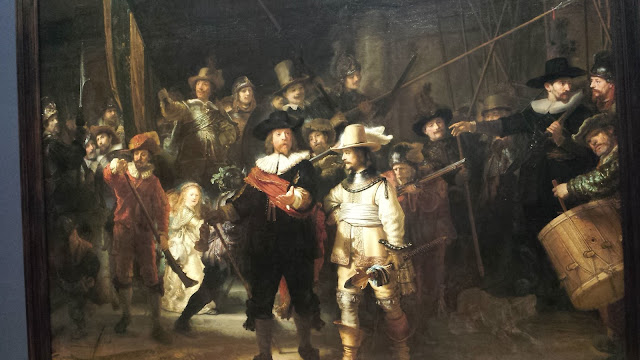
The Night's Watch in the Rijskmuseum

View of Maastricht from Sint Servassbrug

View of the Basilica of Sint Servatius and Janskerk

The Westwork of Sint Servatius

The treasury in Sint Servatius

The interior of Sint Servatius

The imposing facade of the Basilica of Our Lady

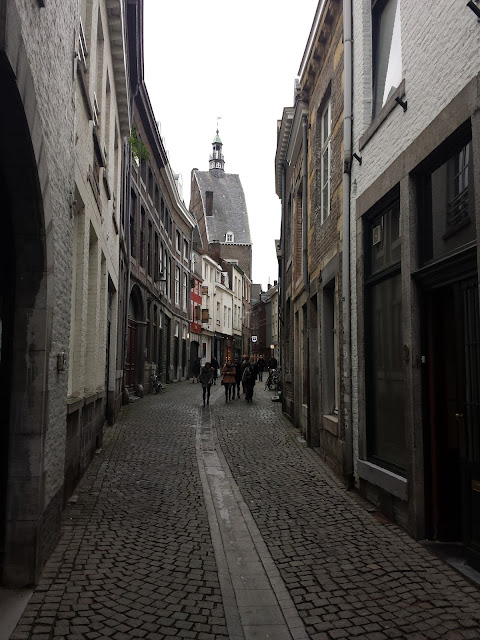
One of the streets in Maastricht

The Dominicanenkerk now a bookstore

The Bonnefanten Museum

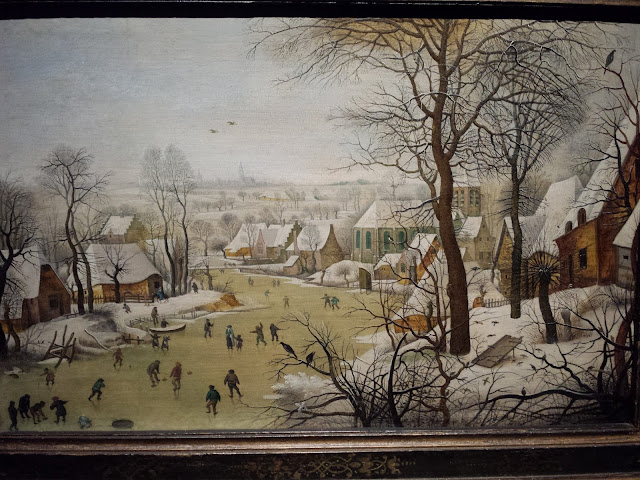
The Bird Trap by Pieter Brueghel the Younger


Saturday, March 12, 2016

Riva del Garda (17/01/2016)

It was a really sunny weekend and despite the cold january weather, I saw that the lake was going to be quite warm (as it is always hotter than in Vicenza). We left at around 10 and after about an hour and a half reached the northern tip of Lake Garda, where the town of Riva del Garda sits. We parked the car right outside the town center and continued on foot. We headed directly to the lakeshore, where a crystal clear water reflected the beautiful surrounding mountains and cliffs and with a fantastic sunny weather. We then passed by the castle which is now the city museum that was unfortunately closed; from the we entered the actual walled town center and headed for the main church. It had just closed so we weren't able to see it, but we just enjoyed it from the outside square, Piazza Cavour, with the nice bell tower towering above one of the northern medieval gates. From there we walked along the narrow streets, passing by a church that was transformed into a city gate, and passing by yet another medieval city gate; St Mark's gate. Further on we ended up at the town's main square; Piazza 4 Novembre, with the imposing and beautiful medieval bell tower (which was also closed and would open from March the 1st) and an amazing view of the lake opening out from the square and palaces. The town was quite small yet very nice so it didn't take long to see. We still had time so we decided to have lunch at the nearby medieval village of Tenno. After a 15 minute drive we reached the small medieval village of Canale di Tenno, considere to be one of the most beautiful villages in Italy. Though tiny, it was amazing, since all the houses were built in stone, the streets were narrow, and all around were artists houses with so many things to see. After walking around a while we got back in the car and headed down towards the medieval village of Tenno. There we ate at the local restaurant called Antica Croce, with some really delicious dishes. After lunch, before heading home we explored the village with the really nice castle overlooking the ton center and an amazing view over the lake. Then right before sunset we got back in the car and headed back to Vicenza.

View over the lake

View of the lake from the town

The castle


The medieval St. Mark's gate

The main square with the medieval bell tower

View of the mountain overlooking the town

The small village of Tenno

The stone houses in Canale di Tenno

The artists decorations throughout the village


View of the village of Tenno with the castle and the lake in the background

View of the lake from Tenno


Tuesday, March 1, 2016

Asti (27/12/2015)

After staying for Christmas at my relative's house in Alessandria in Piedmont, we decided to visit the nearby town of Asti, since the weather looked beautiful. So we left in the morning and on the highway it only took us 20 minutes to reach it. We parked the car right outside the city center and started our visit with the Church of San Pietro in Consavia. The church complex built in the 12th century consists of a small church, a 13th century cloister and a beautiful heptagonal Baptistery. The Baptistery also called Rotunda had some beautiful Romanesque columns and a really nice baptismal font at its center. The whole complex was really nice, though we didn't manage to get to see the archaeological museum on the second floor since it was closed that day. From there we walked on towards the city center, passing by the Troyana Tower; a really nice 12-13th century tower 44m high wonderfully decorated, though also closed. We then reached the beautiful Piazza Cattedrale with the view of the side of the immense Cathedral. The church built in the Gothic style with a tall squared bell tower and the nice southern door decorated in the 15th century. The inside nicely decorated in the 17th and 18th century Baroque style had some impressive pillars and a really interesting 12th century mosaic below the main altar. We then walked on and reached the far western part of the city, where the impressive so called Red Tower, which served as one of the towers of the roman walls, now serves as the bell tower of the church of Santa Caterina. From there we turned around back towards the city center and passing by the De Regibus tower, another of the many that dotted the city of Asti, we reached the crypt of Sant'Anastasio. Now an interesting museum, which contains several artifacts dating from the roman and medieval eras found throughout the city. The crypt dating from the 11th century has some wonderfully decorated columns and sits at the exact location where it once stood, right under the church of Sant'Anastasio which was demolished in 1907. The woman that guided us throughout the small museum was really kind and informative and answered all our questions. After the visit we walked on passing yet another tower, the Comentina tower and reached the second largest and second most important church in town: the Collegiata San Secondo. Built in the 13th century in the Gothic style it had a nice interior with some medieval frescoes still remaining and a nice chapel showcasing the flags of all the participants to the Palio of Asti. It was nearly time to go, so right before leaving we had a quick yet really tasty lunch with wonderful agnolotti pasta with cheese, delicious!

The heptagonal Baptistery San Pietro in Consavia

The church of San Pietro in Consavia

The Troyana tower

The interior of the Cathedral

The side view of the Cathedral

The roman Red Tower

The crypt of Sant'Anastasio

Tuesday, February 23, 2016

Ponte di Legno (4-5/12/2015)

My brother and I decided to join Davide, our aunt's boyfriend, on a ski trip to Ponte di Legno. Even though it had been sunny and dry all month we were hoping the artificial snow would be also good. After arriving Friday night we had a quick dinner and the hotel we were staying at in the small village of Temú and went straight to bed. The next day we woke up early at 7am to start skiing right away. After a quick but filling breakfast we headed to the nearby slopes and started skiing. Most of Temú's slopes were in the shade so the snow wasn't bad, however we decided to use the well connected lifts that took us through Ponte di Legno and eastwards in Passo del Tonale which was really bad since it was completely under the sun and the snow was already mushy in just two hours after the opening of the slopes. We then decided to head all the way up to the Presena Glacier, which reaching a height of 3000m was the only spot with real snow. The slope there was amazing, but it was just one and not too long, so after 4 times we descended it we then went back to Temú's slopes. We had a nice lunch outside while sunbathing and then decided to head back to the hotel since we were getting tired and the slopes weren't skiable anymore by how much mushy the snow had become. So after waiting a few minutes for Davide, we got in the car and headed for Ponte di Legno to walk a bit, around its town center. The town looked really nice with some old buildings remaining and some really nice wooden bridges spanning a small river, probably those from which the town took its name from. Being it dark already it was really nice to see the many lights and decorations all around town which had been set up and ready for the incoming Christmas holidays. After a relaxing stroll around we headed back to our hotel and had a plentiful dinner with the delicious local food. The next day we woke up early again but this time decided to hike rather than ski due to the mushy snow we did not enjoy the day before. The owner of our hotel suggested to us a nice hike which would take us to some WWI trenches nearby. So we set off and passed the small village of Villa Dalegno, and after heading up a steep path which led us through forest first, the open fields and finally up the rocky side of the mountain to our destination: the Bocchette di Val Massa. Where two mountains made of different types of rock met, there was a narrow pass that seemed of strategical importance during world war I when the italian army decided to build what seemed to be a small Great Wall similar to that in China but obviously much smaller in size. It was nonetheless breathtaking to look at since it wiggled its way up the side of the snow capped mountain and making us wonder how much it must have taken the soldiers to construct it. It was also particular in that it was entirely made in schist which was taken form the nearby mountain and surely contrasted with the rock from the other mountain it sat on. We walked the full length of it, looking through the machine gun positions and the tunnels and huts built by the soldiers who took shelter in such a cold and unpredictable environment. After a quick and unsatisfying sandwich we decided to start heading back down, after a couple of hours we reached Villa Dalegno again we luckily found a restaurant which was still open and decided to eat there being still very hungry. We were then back in Temú where Davided had just come back, ready to leave and go back home in Vicenza, after a pleasant yet quite tiring 5 hour hike. 

The Presena Glacier

Ponte di Legno

View from Villa Dalegno

The hiking path

View of the Adamello mountains

View from the top of the trenches

View of the complex of the trenches

Monday, February 22, 2016

Prato and Pistoia (20/11/2015)

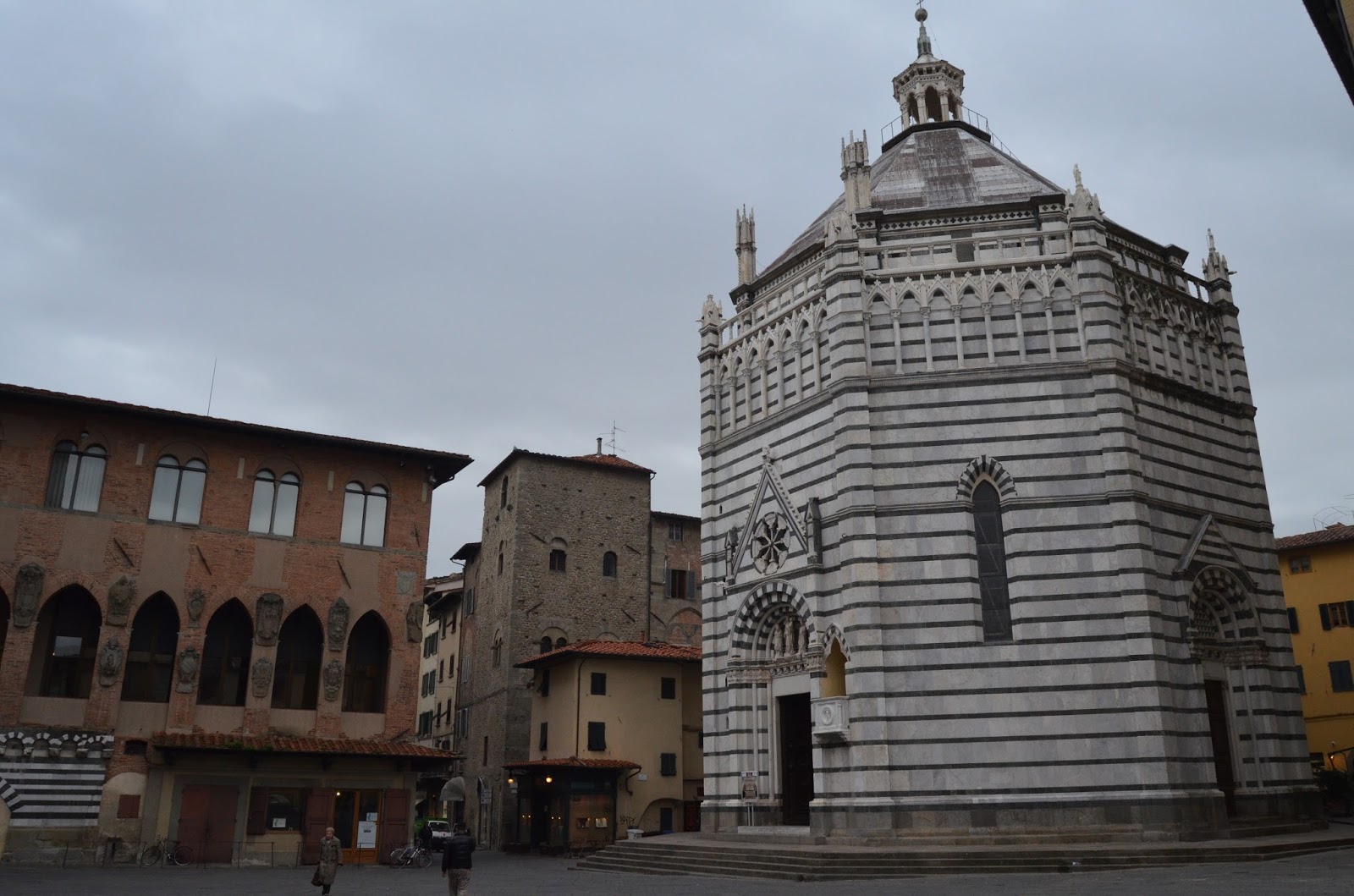
It took a while before everyone was ready to leave, so we took a late morning train headed to the nearby town of Prato. After getting off the train I immediately started noticing the high number of chinese immigrants in the city (the highest in Italy) while walking towards the city center. We walked through the medieval streets and reached one of the main squares: Piazza del Duomo. As the name suggest, this is where the Cathedral with its beautiful serpentine decorated exterior. Started in the 10th century it was majorly modified in the 15th century, particularly on the facade, in the late Gothic-Romanesque style, though the bell tower still dates from the 12th century. One really rare and interesting thing was the external pulpit built by Michelozzo and Donatello which was used, and still is, to show to the public the Girdle of Mary on special occasions such as Christmas, Easter etc. We then entered inside, which was also decorated with serpentine, and the far end chapels contained some nice 14th and 15th century frescoes. We didn't have time to see the museum annexed to the Duomo, so after heading out and seeing the really nice marble fountain at the center of the square. After walking some more we reached the small Piazza del Comune, which still is the center of the city's administration. One side was the newer 17-18th century Town hall which also hosts the civic museum which we didn't see, while on the southern side was the fortified Palazzo Pretorio dating from the 13th century with beautiful arched windows decorating its sides. From there we went a little further and reached the really nice square of San Francesco, with the church of St. Francis on its eastern end, and  a nice column in the center with a small but pretty fountain right next to it. Right behind the church, we reached the large Piazza Santa Maria delle Carceri, which takes its name from the large Basilica on the northern end which was unfortunately closed. Looming over the square is the larges squared Castello dell'Imperatore, so called because of the Holy Roman Emperor, Frederick II. Built in the 13th century it has some massive white stoned walls, with 3 fortified towers per side. We were able to climb the walls for free, where we had a beautiful, despite the cloudy day, view of the city.It was time to go back to the train station and head to our next destination; Pistoia. After a short train ride, we reached the town of Pistoia and headed directly towards the city center. After a 10 minute walk we decided to rest and have a snack in a bar. We found one right in front of the church of San Giovanni Fuorcivitas with a beautiful decorated side in white marble and green serpentine typical of the Romanesque of the area. I had a local sweet and then we headed on towards the main square. We reached the large Piazza del Duomo, with beautiful buildings all around it, thus conisdered one of the best looking in Italy (though very nice I would not consider it amongst the most beautiful). Right on its southern part stood the beautiful Baptistery, nearly larger and surely more imposing than the Cathedral itself. Both and with the immense bell tower were built in the 12th century in the typical Romanesque style in white marble and green serpentine. Though unadorned and without frescoes, apart from a beautiful central baptismal font, the Baptistery still had a nice looking inside, though surely much better from the outside. We then went inside the Cathedral; though badly lit we could still see most of the Romanesque structure and columns. It had some later additions, such as the baroque presbytery and altars,and some older parts with medieval frescoes still remaining. the main things inside were a silver altarpiece dedicated to St James and a 13th century crucifix. After exiting the Duomo we headed down a nice medieval street which took us in front of the Ospedale del Ceppo, One of the oldest and most prestigious hospitals in Europe and quite prolific during the Renaissance when it had its facade decorated in a beautiful ceramic glaze frieze with figures depicting the acts of mercy. Walking further on we reached the Church of Sant'Andrea which didn't look like too much from the inside, but once inside, though very badly lit, I marveled at the beautiful one of the most famous pulpits in the world. The masterpiece by Giovanni Pisano is a beautiful example of Gothic pulpit with incredible decorations, though it could be more appreciated if it were well lit. From there it was time to go so we walked back through the city center and reached the train station where we took the next train headed to Florence, hoping to come back to both these great cities which I wasn't able to visit thoroughly.

The Piazza del Duomo with the Cathedral of Prato

The Palazzo Pretorio

The Basilica of Santa Maria delle Carceri and the Castello dell'Imperatore

The Duomo of Pistoia

The Romanesque Baptistery

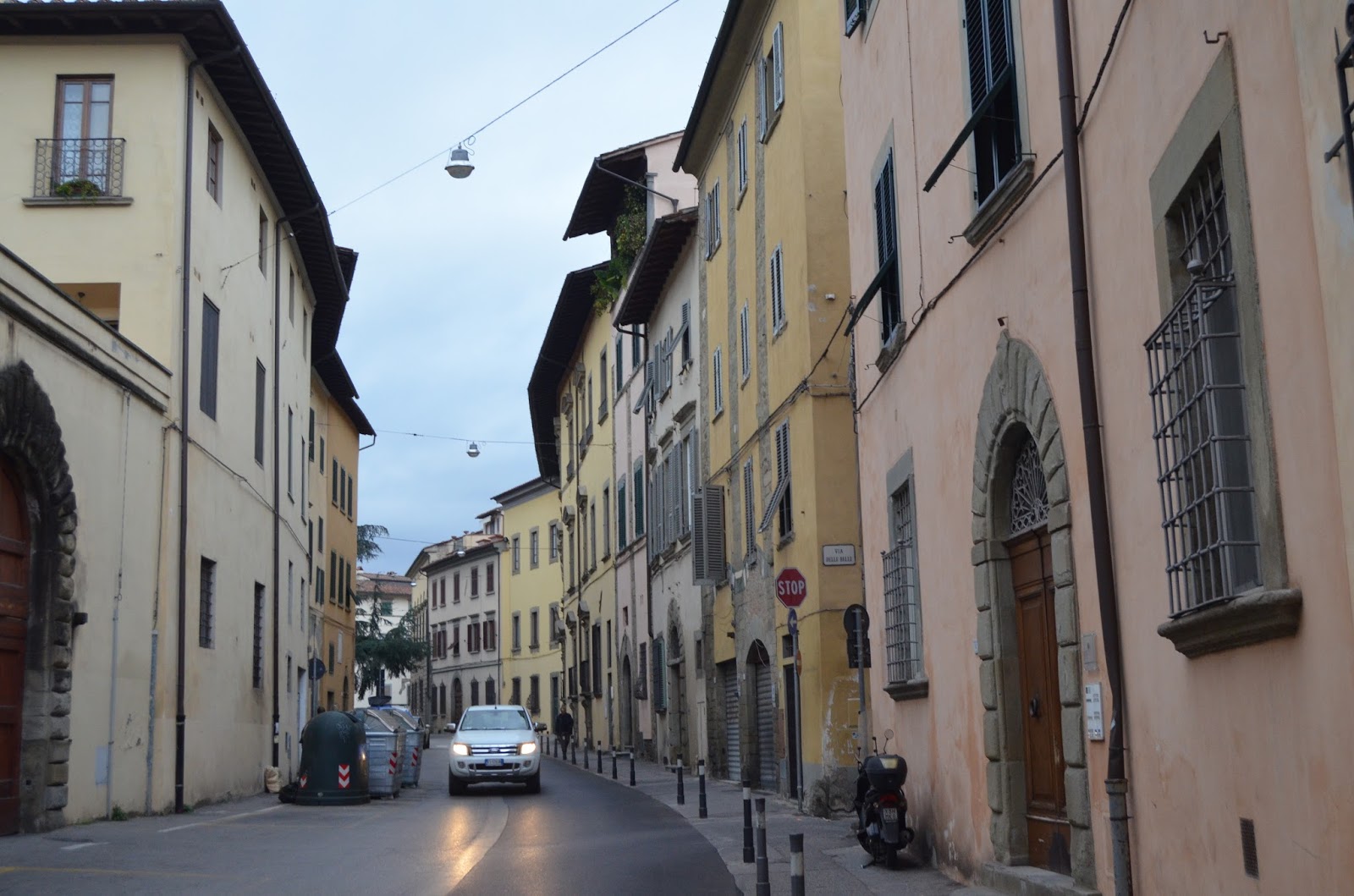
One of the streets in Pistoia