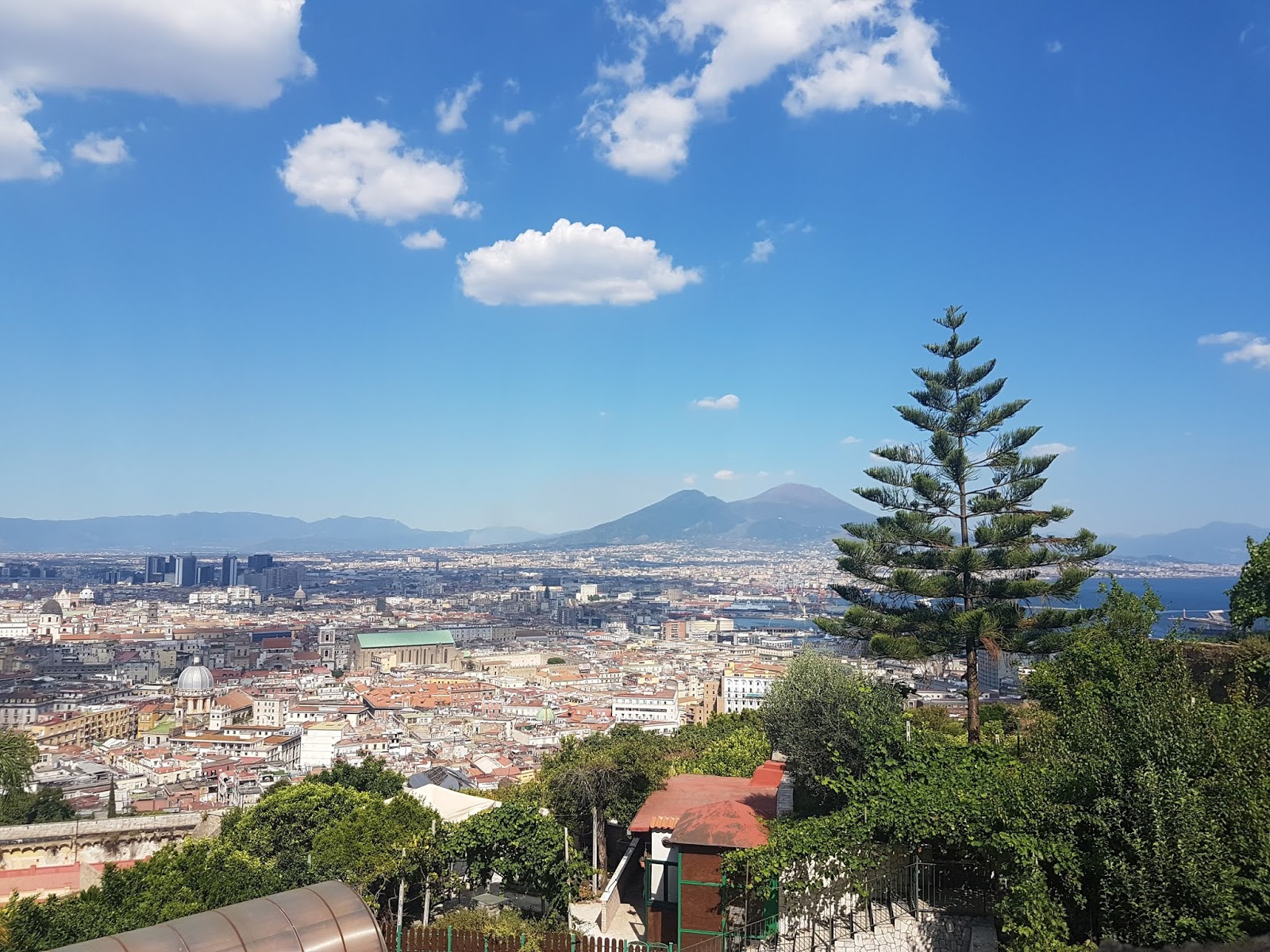
After spending a week in Krakow for the Intensive Program of our master studies, we headed for Katowice airport where we took a flight to Naples. After arriving at the airport we took a bus which brought us to the city center and then took the metro which brought us downtown. As we had luggage with us, I had looked up a place to leave it and thus headed for the port where a guy managing a parking lot offered to hold the luggage for the day for just a few euros. From there we headed towards the main touristic area first passing by the impressive Castel Nuovo, also known as Maschio Angioino, a part medieval part renaissance castle. A little further on we walked through the Galleria Umberto I a public shopping gallery built at the end of the 19th century in imitation to the one of Milan. Walking along the city's main shopping street, Via Toledo, we then stopped at a local eating place where we had the cuoppo, a bag of fried fish for me and fried vegetables for Ania. After lunch, we then crossed through the Quartieri Spagnoli, a tight alleyed neighborhood which used to hold the Spanish garrison when the Kingdom of the two Sicilies was still formed. Walking uphill the whole time we eventually reached the top where the Castel Sant'Elmo and the Certosa di San Martino are located. From there, a large terrace enabled us to have an incredible view over the old town, bay of Naples and the Vesuvius in the background. From there we then walked down the long staircase and through more small streets eventually reaching the seaside. From there we walked by the Castel dell'Ovo, a castle located on a former island, overlooking the Bay of Naples. Further on we reached the huge Piazza del Plebiscito, with the Royal Palace at its eastern end and the Church of San Francesco di Paola at its western one. Built in the Neoclassical style in the mid 19th century, it holds a long colonnade on either side of the main structure and an impressively large dome which we saw from the inside too. Walking further through the old town, we then reached later on the Piazza del Gesù Nuovo with the beautiful baroque plague column or Spire of the Immaculate Virgin at its center. On the square stands also the Church of the Gesù Nuovo, one the most beautiful in the city particularly due to its impressive baroque decorations inside. Opposite stands the Gothic church of Santa Chiara with a cloister filled with maiolicas which I had previously visited the last time I was in the city. After that, we reached the Via San Gregorio Armeno, famous for its traditionally-made nativity scenes. Close by we stopped to eat at a pizzeria which had really good and cheap pizzas: the two of us shared a large margherita and a beer. It was then time for us to head back to take our luggage from the port, and then take the metro which would bring us to the train station. After reaching the station we then took the next train headed to Salerno where we would spend a week at my aunt's house.
The next day we decided to walk from my aunt's house to the nearby town of Vietri sul Mare. The walk took just over half an hour and we were going through the small picturesque streets of the town filled with colorful ceramics which make the place famous worldwide. Walking down the alleyways and passing by the Church of San Giovanni, the main one in town, we eventually reached the beach. There we laid ourselves on the sand and enjoyed a quick swim and a bit of relaxation. Then we decided to head back to Salerno, where half an hour later, walking through the city center we managed to find a pizzeria where we stopped to have lunch. After eating we then decided to see the old town and visit the Cathedral. Then walking along the seaside, we admired the sunset heading back home in time for dinner.
The day after we decided to go to the port and take a boat headed for the town of Amalfi. After passing by the beautiful coast that characterizes this part of Italy, known as the Amalfi coast, with incredibly blue waters, high mountains, and picture-perfect towns, we reached the town which gave the coast its name: Amalfi. Once we got off the boat we headed towards the main attraction, the Cathedral, originally dating to the 9th century. A century later another church was built next to it and now together they form a whole complex. The main church was altered throughout the centuries and thus possesses a Baroque interior while the beautiful facade was remade during the 19th century in a Neo-romanesque style. The bell tower is the only feature (together with the cloister which we didn't visit) which maintains its original style. Soon after visiting a bit of the old town we headed down to the port and took a bus which brought us to the small village of Bomerano where the Sentiero degli Dei, or Path of the Gods, would take us across a mountain in the direction of the town of Positano. The path leads through beautiful Mediterranean shrubs, trees, and grants incredible views over the whole coast clearly proving why it is called like that. After a two hour trek, we were finally in sight of Positano. Descending down from the small hamlet of Nocelle, we reached the colorful Positano nearly one hour later, walking through its narrow alleys and decorated walls reaching the beach tired but satisfied. After a well-deserved rest on the shore, we then headed for the small port waiting for the next boat which took us to Salerno, heading east as the sun set over this beautiful coast.
The following day we headed for the train station and took a local regional train to the town of Pompei. After leaving the station we first headed to the Shrine of the Virgin of the Rosary of Pompei, an impressive Basilica built at the end of the 19th century and containing a lavish interior. Nearby we the queued for tickets to get inside the world-famous archeological site of Pompeii, the Roman city destroyed and covered by the eruption of Vesuvius in 79 A.D. After getting our tickets an entering the archeological area we walked around the splendid ruins and perfectly preserved examples of Roman life during the imperial area, specifically with mosaics, wall frescoes, rooms etc. Our walk took us over three hours and, even though I had been here before, still managed to see parts I had previously not seen. Then we decided to head out, as we covered most of the area and the sun had gotten unbearably hot, to catch the next train back to Salerno. The morning after, we decided to do another day trip this time heading south and reaching the town of Paestum. Here we visited the archaeological ruins of a major ancient Greek city which dates between 600 and 450 BC lasting until nearly the middle ages. We visited some perfectly preserved temples which predate the Parthenon and were much more lavish at the time they were built. After walking through the ruins we also gave a quick look at the National Archaeological Museum next door, which holds all the artifacts and objects which were excavated from the site including some splendid painted tombs. After that, we took a local bus which we had to wait for a while that took us to the town of Agropoli. Once we reached the destination we started walking through the old town climbing uphill, through the medieval streets and reaching the castle, originally built by the Byzantines and then refurbished by the Aragonese. The view from there was beautiful spacing from the Amalfi coast in the distance to Salerno and the plains around it. After having lunch in a place which I had previously eaten at, we continued on foot outside of town eventually reaching the bay and beach of Trentova. We relaxed there for a while, swimming a few times too. After that, we headed back to the town and took a train back to Salerno. The next two days, we decided to remain in the city and relax while just heading out to see a bit of the center and enjoy the beach a bit.
On the 11th we woke up early to take the train headed for Rome. After getting off at Rome's main station we got a local train which brought us to the neighborhood of Trastevere where we booked a room to sleep in for the time we would stay in the city. After managing to check in and leave our luggage we then went out to explore the city. We passed by and visited the Church of San Francesco a Ripa Grande and the nearby Church of Santa Maria dell'Orto with a beautiful Baroque interior. Then walking further we crossed the Tiber river once, entering the small Tiber island where we gave a quick look at the Basilica of San Bartolomeo all'Isola built in the Baroque style. Then we crossed another bridge, the Ponte Fabricio, the oldest Roman bridge in the city still preserved in its original state, and reached the left bank of the river. We walked further and passed by the Portico di Ottavia, a Roman monument which used to hold two temples and then served as a fish market from the middle ages until the 19th century. Nearby we entered and admired the Church of Santa Maria in Campitelli with a really nice Baroque interior. Not far, we reached the Capitoline Hill, one of the famous seven hills of Rome. At its top stands a beautiful square designed by Michelangelo and surrounded by renaissance palaces, including the Palazzo Senatorio now the town hall of the city. Behind the palace, we were able to admire the impressive archeological site of the Roman Forum, with ruins of temples, arches, basilicas and other buildings dating both from the Republican and Imperial era of the Roman times. At the end of the street running along the archeological site, we then reached the world-famous Colosseum, which we decided to skip visiting in its interior due to the long line and high price. For lunch, we stopped nearby at a Spanish tapas chain where we had a quick bite and a refreshing sangria. After lunch, we walked further into town and passed by the Vittoriano, a monument built in honor of Victor Emmanuel the first king of Italy after the 1861 unification. Further on, we reached the Trevi Fountain a beautiful example of Baroque architecture yet completely packed with tourists, as usual. We took an ice cream a bit later on in a side street and reached the Piazza di Spagna. One of the most famous squares in the city, it holds the baroque Fontana della Barcaccia, built by Bernini and the scenic Spanish steps with the Church of Trinità dei Monti at the end of them. Reaching the northern end of the old town we passed through the large Piazza del Popolo and climbed up the Pincio hill where a terrace gave us a great view over the city. After enjoying the view from there we headed back down into town and walking south reached the Column of Marcus Aurelius built in 193 A.D. with reliefs detailing battles against barbarian tribes. Nearby we passed by Piazza Montecitorio with the Baroque palace of the same name and the Egyptian obelisk at the center of the square built around 590 B.C. and brought here during the Roman era from the city of Heliopolis. Walking a little more through the streets we reached the Patheon, an impressive former Roman temple turned into a church. We visited its interior which holds tombs of some Kings of Italy from the 19th and 20th centuries, and the largest unreinforced concrete dome in the world (still even after two thousand years from its construction). Next one we visited the Church of San Luigi dei Francesi, with a beautiful baroque decoration and the Calling of St Matthew by Caravaggio. Close by we entered the picturesque Piazza Navona, built in an elliptical form over the remains of the Stadium of Domitian, and with three beautiful fountains, one of which, the Fontana dei Quattro Fiumi, was built by Bernini. After crossing the large square we walked for a while and reached the Ponte Sant'Angelo, a roman bridge with Baroque statues at which's end stands the impressive Castel Sant'Angelo, which used to be the mausoleum of Emperor Hadrian. Following on we finally reached the large and impressive Piazza San Pietro, with the Basilica of Saint Peter located in the territory of the Vatican. It was however quite late so the entrance was closed, and we decided to come to visit the next day. So feeling quite hungry we decided to find a place to eat, luckily we ended up finding a nice place which served aperitivo buffet: which just 6 euros we had one beer and free refills on all the food available. The place was so good and cheap we decided to come back there the following day too. After feeling satisfied and full we headed to our accommodation where we fell asleep immediately tired from the long day. The next morning, waking up not too early we headed immediately for the Piazza San Pietro. As it was late morning there were already many people in the square so we decided to come later to visit the interior of the church. We walked further crossing the Ponte Vittorio Emanuele II and visited the Church of Santa Maria in Vallicella along the way. Built during the 16th century in the Mannerist style it holds a beautiful Baroque interior with paintings from the 17th century. We then visited the Church of Santa Maria della Pace, built during the 17th century and the contiguous cloister built by Bramante in the early 1500s in a perfect Renaissance style. Later we visited the Museo Napoleonico, as the entrance was free that day, holding several objects and paintings from the 18-19th centuries including the rooms decorated during that period. After the visit to the museum, we crossed once more the impressive Piazza Navona and decided to visit another free museum, the Museo Barracco. The building hosts an interesting collection of ancient sculptures from the Egyptian, Etruscan, Greek and Roman eras. Exiting the museum we headed to the nearby church of Sant'Andrea della Valle, with an impressive frescoed interior, and then the Baroque masterpiece of Sant'Ivo alla Sapienza built by Borromini, a famous roman architect. We then continued further passing by the pretty Obelisk of the Minerva, an ancient Egyptian obelisk with a statue of an elephant made by the famous architect Bernini. A few streets down the way we entered the church of Sant'Ignazio, built during the 17th century in the Baroque style with nice frescoes inside. Nearby we passed by the Temple of Hadrian, or what remains of the columns of that roman temple now incorporated into a later building. We then walked further through the winding streets of the older part of Rome and reached once again the Ponte Sant'Angelo, entering then the Piazza San Pietro where we stood in line to enter the famous Basilica. After finally visiting the impressive church we decided to head somewhere less crowded, and visit the catacomb of San Pancrazio a little outside the city center. After walking for a while uphill we reached the Basilica of San Pancrazio, originally built during the 5th century. After seeing the interior we then waited for the priest in charge to show us the catacomb. The catacomb was built during the Christian persecutions of the Roman empire to bury and mourn the dead and celebrate the liturgies secretly and was very impressive to see. We then learned that the priest who accompanied us spoke Polish as he was from Poland and manage to talk with Ania for a bit. Apparently, there was a monastery of Polish nuns nearby explaining the people walking around the church and speaking in polish with the priest. After the visit, we started to get hungry so we headed into Trastevere and ate at the buffet place again. To digest dinner, we decided to head to the nearby Janiculum hill; walking uphill we reached the Fontana dell'Acqua Paola, an impressive Baroque fountain with an incredible view over the city. We enjoyed the view for a while and then walked to the Janiculum terrace with an even better vista. From the top of the hill, we descended back down to the Basilica of St Peter, walked through the town and reached Piazza Navona once more. From there we headed back to our accommodation as we would have to wake up early the next morning.
After waking up we headed to the Trastevere train station where we took a local train to the main station where we took our train headed for Florence. After an hour and a half train ride we reached the beautiful city of Firenze. After finding a luggage storage in the city center, we decided to walk around town visiting the major monuments and attractions. We started with the Cattedrale di Santa Maria del Fiore which had an immense line waiting to get inside so we deiced to skip the interior and just admire it from the outside. Then we walked through the Piazza della Signoria where the Palazzo Vecchio, or town hall, stands. After that, we crossed the famous Ponte Vecchio, a covered bridge with many shops built on top of it, and reached the other side of town across the Arno river and thus called Oltrarno. From there we started our ascent of the hills south of the city, reached the high point where the Abbazia di San Miniato al Monte stands. We visited the interior of the church which presents a perfect example of Romanesque architecture. From there we also enjoyed an incredible view of the city spanning the entire city center. Right below we then saw another church, San Salvatore al Monte, which was probably built around the same time as the previous church but suffered later additions and refurbishments. After reaching the large Piazzale Michelangelo, a famous platform where people enjoy a beautiful view of the city, we descended back into the old town. We crossed the city center yet again, passing by the Basilica of Santa Croce and reaching the Piazza San Marco where we took a local bus headed uphill towards the town of Fiesole. My brother had told us to come to visit him at the European University Institute where he was working which is located in the Badia Fiesolana, a monstery from the 15th century. After showing us around the premises, we had a lunch at the cafeteria and then went to visit the nearby Villa Schifanoia, a typical renaissance countryside palace. After leaving my brother back to his work we took the bus and headed up to the town of Fiesole where we had a quick look of the town center, the Romanesque Cathedral and a peek at the Roman theatre which required a ticket so we decided not to visit. Once back on the bus we headed down to Florence where we eventually took our train headed for Vicenza.
 |
| The Maschio Angioino in Naples |
 |
| View of Naples |
 |
| Beach and Saracen watchtower in Vietri sul Mare |
 |
| View of Vietri sul Mare |
 |
| View of Amalfi from the boat |
 |
| The Amalfi Cathedral |
 |
| The Path of the Gods |
 |
| View of Positano |
 |
| One of the Roman frescoes in Pompeii |
 |
| A street in Pompeii |
 |
| View of the ruins in Pompeii |
 |
| The temple of Hera in Paestum |
 |
| Greek columns in Paestum |
 |
| The Byzantine fortress in Agropoli |
 |
| The Altare della Patria in Rome |
 |
| St Peter's square and Basilica |
 |
| Piazza Navona in Rome |
 |
| The church of Sant'Ivo alla Sapienza |
 |
| A street in Rome |
 |
| The catacomb of San Pancrazio |
 |
| The monumental Fontana dell'Acqua Paola |
 |
| The bridge and castle of Sant'Angelo at night |
 |
| The Ponte Vecchio in Florence |
 |
| View of Florence |
 |
| View of the city center from the Basilica San Miniato al Monte |